A single weak batch of concrete can put an entire structure at risk. This is why concrete cube tests for M30 and M40 grade concrete are essential, as they check compressive strength at 7 and 28 days and guarantee that the mix meets the required design grade according to IS 516:1959 and IS 456:2000 (IDC).
The test consists of a standard 150 mm cube, which records the necessary data on the project, mix grade, cube ID, casting and testing date, curing age, cube mass, crushing load (kN), and compressive strength calculated (MPa or N/mm 2).
Here in this blog, you will know how 7day and 28day test results can assist in early identification of mix or curing problems, final structural acceptance, and highlight the possible risk in material quality, mix design, or site practices. This will help to take corrective action on time before the construction advances in another direction.
In India, the concrete cube test is controlled by clear codes of The Bureau of Indian Standards (BIS) that help to guarantee the uniformity, reliability, and legal justifiability of the results.
These standards establish specimen size, sampling rate, curing, loading rate, and acceptance. Besides strict adherence to these IS provisions, Bhargava Building Atelier Pvt. Ltd., testing division, also engages in the preparation of the measurement uncertainty of the concrete cubes.
This guarantees statistically proven, verifiable, and defensible strength outcomes in accordance with NABL laboratory specifications, an essential criterion for infrastructure, industrial, and government-supported projects.
Want a complete reference? Download our BBAPL Material Testing PDF to get detailed guidelines, step-by-step procedures, and IS code references.
Accurate concrete cube testing depends on disciplined execution at every stage. Even minor deviations can affect the recorded compressive strength.
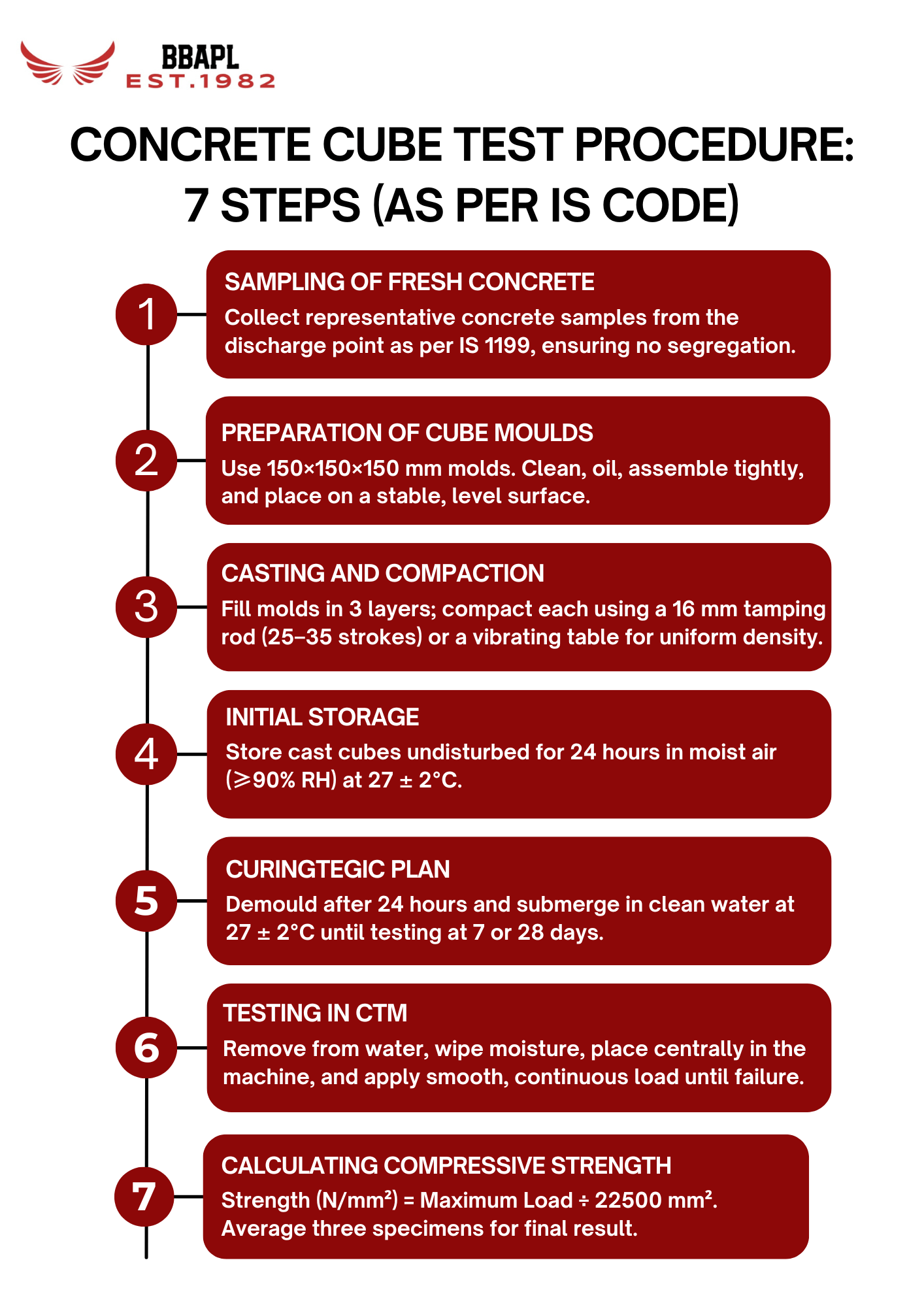
Concrete samples are collected from the discharge point as per IS 1199. The sample must represent the batch and be free from segregation.
After casting, specimens are stored undisturbed for 24 hours in moist air with at least 90% relative humidity at approximately 27 ± 2°C.
After 24 hours, cubes are demoulded and submerged in clean water maintained at 27 ± 2°C until testing at 7 or 28 days.
Compressive Strength (N/mm²) = Maximum Load (N) ÷ Loaded Area (mm²)
For a 150 mm cube: Loaded area = 150 × 150 = 22500 mm². The average strength of three specimens is taken as the representative result.
According to IS 456:2000, concrete acceptance mainly relies on the findings of 28-day compressive strength.
To the project and quality department heads, this phase identifies the approval of structural elements to be put under load and construction to continue.
To maintain consistent quality control, the following provisions are critical:
Standardized testing ensures that every concrete batch meets design strength requirements, maintains quality, and complies with IS codes. This summary highlights key parameters and procedures for accurate and reliable results.
| Parameter | Requirement as Per IS Codes |
|---|---|
| Cube Size | 150 mm × 150 mm × 150 mm |
| Governing Test Code | IS 516 |
| Acceptance Criteria Code | IS 456 |
| Sampling Standard | IS 1199 |
| Curing Temperature | 27 ± 2°C |
| Initial Storage | 24 hours in moist air (≥90% RH) |
| Test Ages | 7 days and 28 days |
| Calculation Formula | Load ÷ Loaded Area |
| Minimum Specimens per Sample | 3 cubes |
The concrete cube test procedure is a key quality control measure, ensuring that the compressive strength of concrete meets design and safety requirements.
When conducted as per the relevant IS code, it provides reliable, documented, and defensible results, helping procurement, engineering, and quality teams make informed decisions.
For expert concrete cube testing and preparation of measurement uncertainty, contact us:
📞 Phone: +91-9630150426
✉️ Email: info@bbapl.in
To verify the compressive strength of concrete at 7 and 28 days, ensuring the mix meets design grade requirements like M30 or M40.
IS 516, IS 456, IS 1199, and IS 10086 cover procedures, acceptance criteria, sampling, and mould specifications.
Concrete is cast in a 150 mm × 150 mm cube, compacted in layers, cured for 7 or 28 days, and tested in a compression machine.
7-day tests highlight early mix or curing issues; 28-day tests confirm final structural strength.
Compressive Strength (N/mm²) = Maximum Load (N) ÷ Cube Cross-sectional Area (mm²). The average of three cubes represents the batch.
At least one sample per 30 m³ of concrete or once per day; more frequent testing is recommended for high-rise or critical structures.
The average of three cubes must meet or exceed the characteristic strength; individual results must fall within permissible limits.
Cubes must be cured for at least 7 days for early checks and 28 days for final acceptance.
Smaller aggregates allow 100 mm cubes; larger aggregates require 150 mm cubes to represent the mix accurately.
Smaller cubes can slightly overestimate strength; a correction factor aligns results with standard 150 mm cubes.
Bhargava Building Atelier Pvt Ltd. ensures all concrete cube strength results are statistically validated and NABL-compliant, providing reliable and defensible data for construction quality.
Yes, it detects weak batches, mix inconsistencies, or curing issues early, allowing corrective action before structural construction progresses.
No related posts found.