As cities grow, the construction sector faces a pressing challenge: building sustainably without exacerbating climate change or further depleting resources. The built environment contributes 37% of global energy-related CO₂ emissions (UNEP). India, now the third-largest market for LEED-certified buildings, has surpassed 12 billion sq. ft. of registered green space (USGBC).
This rapid adoption demonstrates how eco-friendly practices are gaining mainstream acceptance. Green buildings enhance occupant well-being, cut energy costs, and lower ecological footprints. This blog explores their definition, importance, features, technologies, supportive policies, and global case studies shaping the future of sustainable urban development.
Green building practices are more than just an eco-friendly structure. It refers to designing, constructing, and maintaining structures to maximize resource efficiency and minimize environmental impact.
From the building’s original design to its demolition, the sustainable architecture India approach places a strong emphasis on the following:
It is impossible to overestimate the importance of Green building practices in today’s world. Since buildings use almost 40% of the world’s energy, it is imperative to implement sustainable practices. Green buildings are significant because they can:
The approach towards sustainable architecture in India is now essential to ensuring growth in nations like those that are rapidly urbanizing.
These characteristics not only lessen the impact on the environment but also produce sturdy and cost-effective structures.
Also Read: BBAPL’s HVAC, Fire Safety, & Electrical Consultancy
Green offices also improve focus and reduce sick days, enhancing business outcomes. In short, green buildings are investments that benefit both people and the planet.
Read more: BBAPL’s Structural Designing
From BIM-driven predictive maintenance to solar power, LED lighting, green roofs, and geothermal systems, modern technologies are making buildings smarter, cleaner, and more energy-efficient.
Building Information Modelling (BIM) combines AI and IoT for predictive maintenance while minimizing waste and optimizing resources.
These Indian case studies demonstrate how green building principles are successfully implemented at scale using renewable energy, efficient resource management, and smart design. They set benchmarks for sustainability, operational efficiency, and healthier work environments.
Government policies are accelerating green construction through mandatory standards, renewable energy integration, and updated building byelaws. Developers benefit from fast-track approvals, tax rebates, higher FAR, and financial support like depreciation benefits and IREDA-backed loans.
While certifications like LEED and GRIHA are important, the next level of energy-efficient building design emphasizes:
Green building practices are no longer futuristic; they are essential for sustainable growth. By integrating advanced technologies, supportive policies, and rising eco-conscious demand, they create resilient, cost-effective, and healthier urban spaces.
From Suzlon One Earth’s energy independence to Titan’s Integrity Campus and Brazil’s Museum of Tomorrow, these projects prove green buildings are redefining sustainability and the future of real estate.
Ready to make your next project greener and compliant? Call us at +91-9630150426 or email info@bbapl.in to get started today.
Green buildings are designed to reduce environmental impact through energy efficiency, sustainable materials, and improved indoor quality.
They cut carbon emissions, save energy and water, lower costs, and support sustainable urban growth.
BBAPL integrates eco-friendly design, material testing, and structural planning to ensure sustainable project execution.
BBAPL provides PMC, structural design, testing, and turnkey solutions aligned with green standards.
Yes, they reduce utility costs, enhance durability, and increase property value over time.
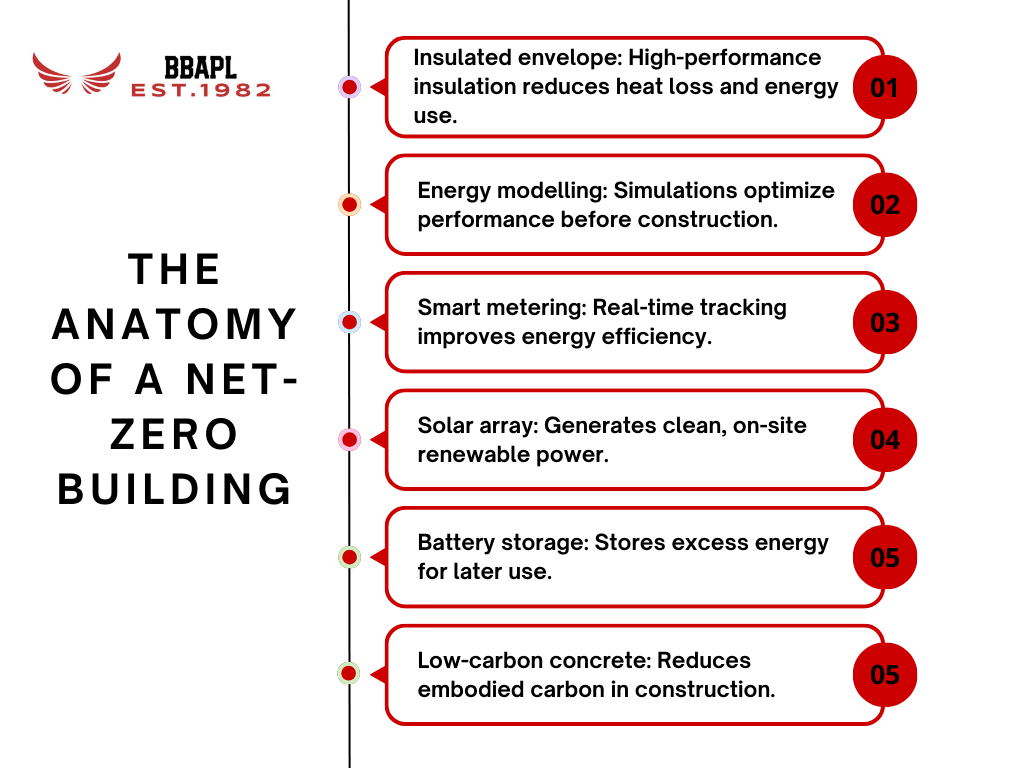
A net-zero building generates as much energy as it consumes annually through efficiency and renewable energy systems.
Green buildings reduce environmental impact, while net-zero buildings aim for complete energy balance.
Initial costs may be slightly higher, but long-term savings in energy and maintenance offset the investment.
Most net-zero projects achieve payback within 3–7 years through energy savings.
Yes, through retrofitting with insulation upgrades, solar panels, smart systems, and energy-efficient equipment.
Solar is the most common solution, but other renewable sources like wind or geothermal can also be used.
Not always. Certifications focus on sustainability standards, while net-zero requires measurable energy balance.