How do you verify concrete strength on-site before visible damage appears? Concrete fails quietly before it fails visibly. It is not until a crack develops on a column or the slab starts to deflect that the structural risk, as well as the financial impact, is exaggerated. With the global construction expenditure expected to increase to almost 22 trillion by 2040, necessitating a CAGR of 3.2% , the strain on quality control measures is mounting across the globe on the project (Mckinsey).
Still in this high-growth, high-stakes environment, it is essential to have reliable on-site strength verification. The rebound hammer test presents one of the quickest and most viable methods of measuring concrete strength without stopping work. Here, in this blog, you will be informed about the rebound hammer test procedure. Proper on-site process, interpretation of the results according to the IS standards, and determining when this non-destructive test is adequate and when additional testing is required.
The rebound hammer test, or Schmidt hammer test, is a non-destructive concrete test that is used to determine the hardness of the surface. A spring-loaded plunger hits the concrete surface, and the distance that the hammer bounces back is documented as a Rebound Number (R). The greater the rebound number, the harder the concrete, and most of the time, the more powerful.
The device converts the hardness of the surface to an approximate compressive strength in a correlation graph or an IS-approved table. It never supersedes cube testing, but it will give you a point to start with.
Facts: The rebound hammer test can cover an entire floor plate in a fraction of the time it takes to extract and test a single core sample.
Executing the test correctly is everything. Any uneven surface or wrong angle will give untrustworthy results and conclusions.
After getting your average rebound number, plot it on the correlation graph given to you by the manufacturer or the graph of IS-referenced. The rebound number is plotted on the X-axis, whereas the estimated compressive strength is on the Y-axis in N/mm 2. The majority of graphs give individual curves depending on which way the hammers are placed: vertical, horizontal, or inclined downwards.
Key Stat: Rebound hammer measurements are considered to determine in-situ concrete strength within an error of +/-20 percent. When this is combined with due calibration and surface preparation adequate enough to do preliminary screening on-site.
Construct a simple spreadsheet whose columns are: Location ID, Date, Hammer Orientation, Individual Readings (minimum 9), Mean Rebound Number, Estimated Strength (from graph), and Pass/Fail against design grade.
It is this information that should be kept so that it can be tracked to audits, client reports, and handovers.
IS 13311 (Part 2): 1992 governs the use of the rebound hammer in India. Key requirements include:
Only one rebound reading should never be used in making on-site decisions. The engineers need to consider the average values, patterns of variations, and site contexts before establishing that the structure is adequate or indicating further research.
This is exactly the kind of scenario where the rebound hammer test proves its value in the field.
Bhargava Building Atelier Pvt. Ltd. has recently done a combined Rebound Hammer and UPV (Ultrasonic Pulse Velocity) test on the 20 TPH boiler area of the JK Tyre Industries Ltd. This is a structurally critical industrial zone wherein concrete integrity directly affects the safety of operation.
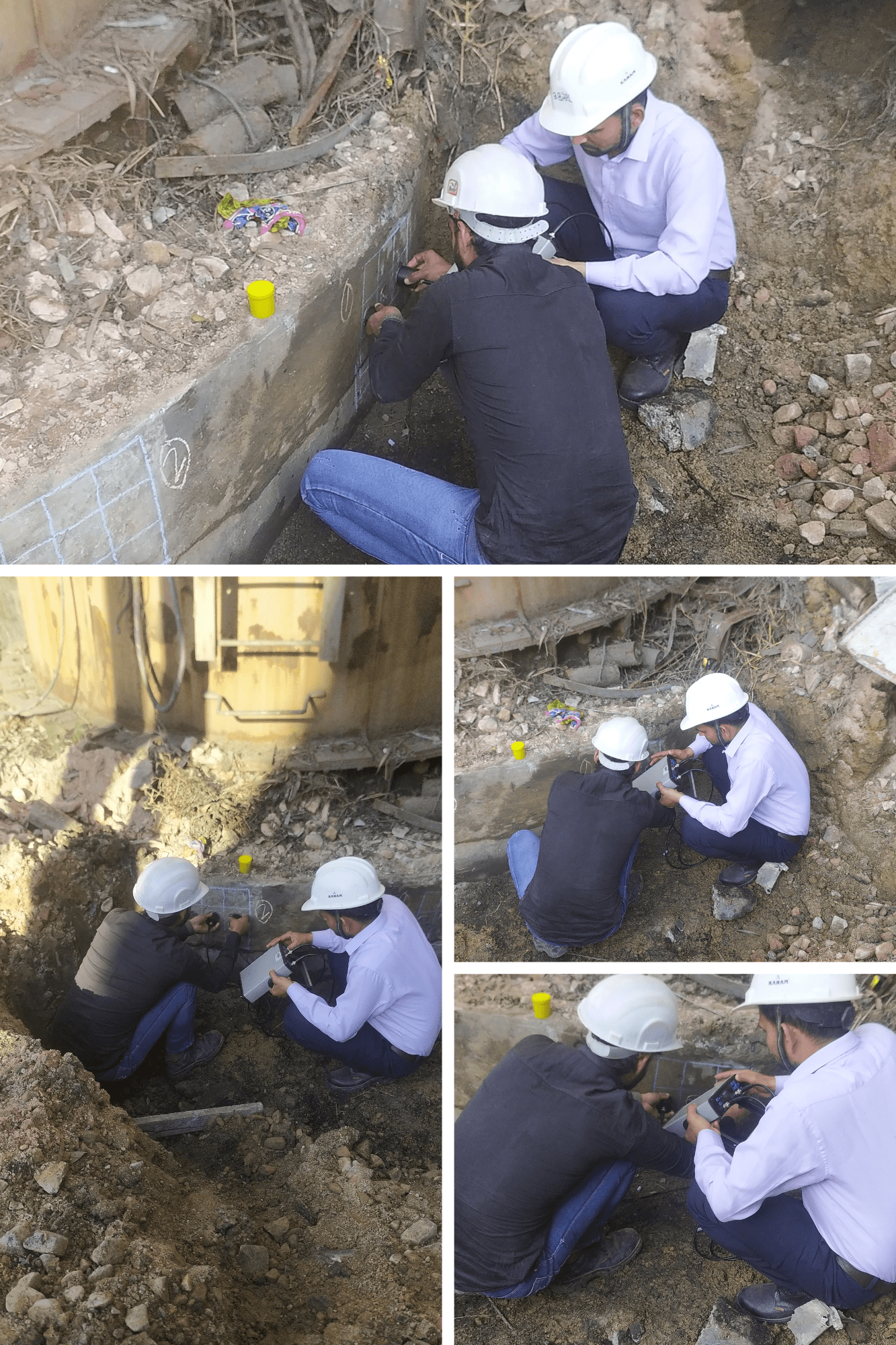
The two-test method provided the site team with data on the hardness of the surface and internal homogeneity. This is much more complete than the results of either of the tests on its own. It is a real-life warning that in high-risk industrial settings, the rebound hammer test is not just a part of the site formality. It is the first line of structural responsibility.
Continue reporting clean and decision-oriented. An effective test report must entail the date of the test and test location, the concrete grade to be used, the average number of rebounds, the predicted strength, the compliance status of the IS code, and clear instructions.
Choosing the right testing method depends on your project stage, risk level, and required accuracy. While the rebound hammer is ideal for quick, non-invasive preliminary checks, other non-destructive and destructive methods may be necessary when precision and structural validation are critical.
| Method | Speed | Cost | Invasiveness | Best For |
|---|---|---|---|---|
| Rebound Hammer | Fast | Low | None | Preliminary survey |
| Ultrasonic Pulse Velocity | Moderate | Medium | None | Homogeneity assessment |
| Core Sampling | Slow | High | Destructive | Definitive strength value |
Also Check: Rebound Hammer Test vs Core Test: Which One Should You Trust?
The rebound hammer test delivers maximum value when integrated into a structured site quality control framework, not when used as an isolated acceptance tool. It enables rapid screening, highlights inconsistencies across pours, and helps you deploy core testing strategically where verification is genuinely required.
When aligned with cube test data, inspection logs, and proper documentation, it strengthens your compliance position and creates a technically defensible, audit-ready QC system that protects both the structure and your professional accountability.
For certified on-site testing, structural audits, and compliant reporting support, BBAPL is ready to assist.
📞 Call us: +91-9630150426
📧 Email: info@bbapl.in
Yes, it can be used in different orientations. Proper correction factors must be applied for accurate results.
It can assess surface hardness after fire exposure. However, a detailed structural evaluation is usually required.
No, it only measures surface hardness. Internal voids or deep cracks require other testing methods.
Periodic servicing ensures consistent performance. Calibration should follow manufacturer recommendations.
It is useful for preliminary assessment reports. Final certification generally requires supporting test data.
Yes, it is suitable for assessing existing concrete. Its non-destructive nature makes it ideal for audits.
Yes, harder aggregates may give higher readings. Material composition can slightly affect results.
Yes, it helps evaluate existing surface strength. It supports decision-making before repair planning.
Yes, BBAPL conducts certified on-site rebound hammer testing. It also supports structural audits and compliance reporting.
No related posts found.