The design, fabrication, and assembly of buildings are being revolutionized by modular construction. Modular construction is the future of construction India. As per McKinsey the modular construction accelerates project timelines by 20–50% by constructing building components in a factory while on-site preparation occurs simultaneously, eliminating weather delays and reducing on-site labor needs.
Despite accounting for more than 8% of India’s GDP, the construction industry continues to face obstacles like a lack of workers, weather-related delays, and logistical limitations.Modular construction, backed by expert PMC services in India, ensures projects are efficiently planned and executed.
Using BIM for digital coordination and following the National Building Code of India (NBC) guarantees compliance, safety, and modern construction standards. With the future of construction India and the urban population predicted to reach 600 million by 2031, modular construction offers a creative way to satisfy the country’s expanding need for commercial, industrial, and residential infrastructure.
India’s construction sector is rapidly evolving, and modular construction, powered by smart techniques, delivers clear advantages.
Also read BBAPL’s Structural Design Service
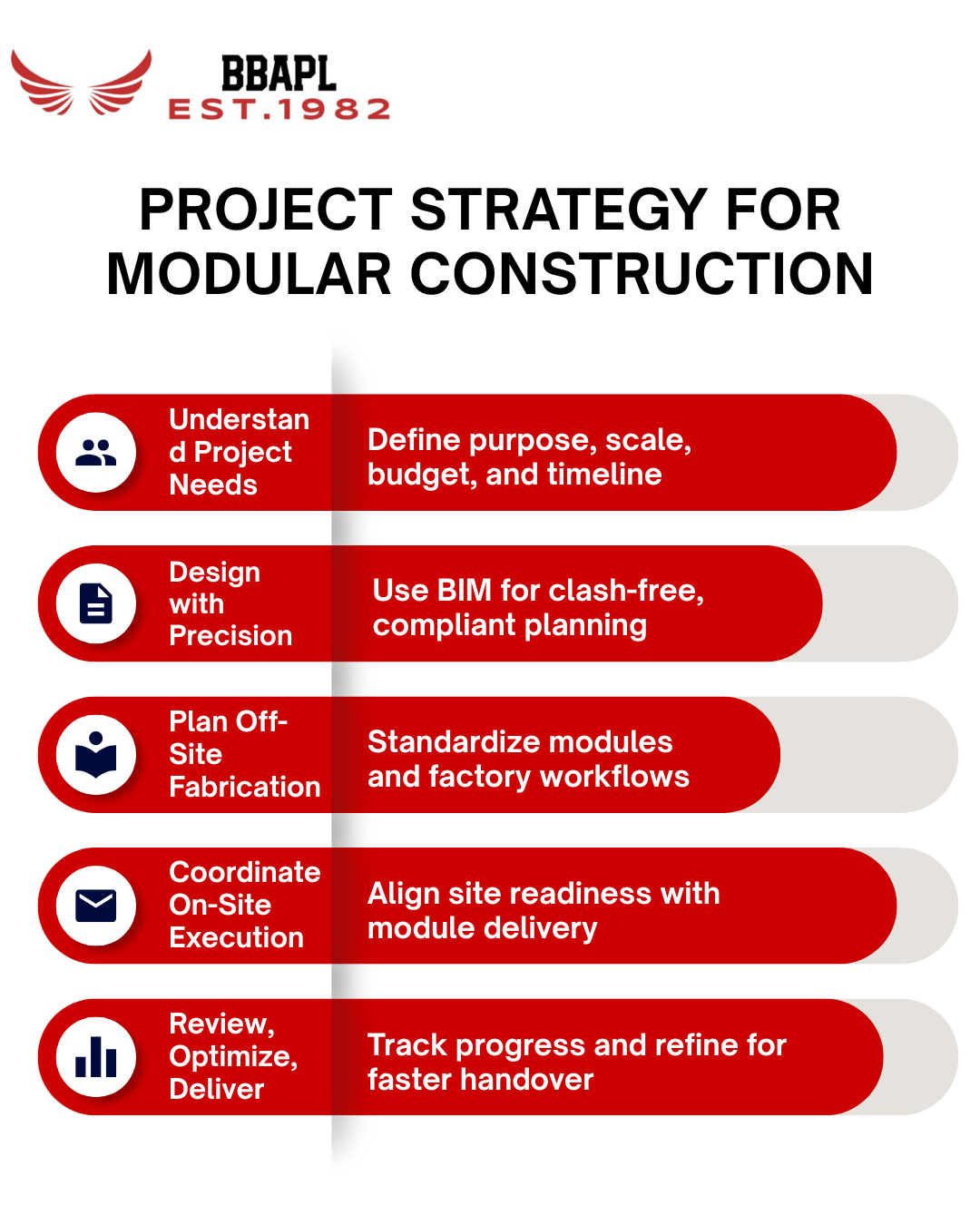
The ability of modular construction to significantly cut costs and time is one of its biggest benefits. Due to labour shortages, material shortages, or erratic weather, traditional construction frequently experiences delays. These risks are reduced by modular construction
Read more BBAPL’S Project Management Consultancy Service
Modular construction has spread throughout a number of industries in recent decades. It was first widely used for residential construction, but today it also includes commercial buildings, hospitals, schools, and industrial projects. The following are important trends influencing the industry
Read more BBAPL’s Architectural and Interior Design Service
Prefabricated buildings India is experiencing a growing demand for commercial space, housing shortages, and urbanisation. These issues can be uniquely addressed by modular construction
The adaptability of modular construction and modern construction techniques is demonstrated by a number of noteworthy projects in India and around the world
To overcome these obstacles and hasten the adoption of modular construction and Prefabricated buildings India, it will be essential to implement ongoing technological advancements, awareness campaigns, and skilled workforce development.
Modular construction still has challenges in spite of its benefits
To conclude, modular construction and prefabricated buildings in India are shaping the future of construction in India, offering a smarter, faster, and more sustainable alternative to traditional methods. By integrating modern construction techniques and smart construction techniques, Bhargava Building Atelier Pvt Ltd ensures projects are delivered with superior quality, efficiency, and cost-effectiveness.
With the rising emphasis on green building standards by organizations like the Indian Green Building Council (IGBC), adopting modular construction and leveraging professional PMC services in India is no longer just an option, it’s a strategic move towards building a resilient and sustainable urban landscape.
Ready to experience the future of construction? Explore our modular construction services or contact us today to discuss how BBAPL can bring your project to life with precision, speed, and sustainability.
Modular construction involves building sections or modules off-site in a factory, which are then transported and assembled on-site.
Modules are fabricated while site preparation occurs simultaneously, cutting construction time by up to 50–60%.
Yes, factory-controlled processes, reduced material wastage, and efficient resource planning make it more economical than traditional methods.
Residential, commercial, industrial, and mixed-use developments can all benefit from modular construction methods.
Professional PMC services ensure precise planning, project management, and execution, maximizing efficiency and quality.
No. Modular construction works for small, mid-scale, and large projects, including offices, housing units, industrial buildings, and temporary structures.
Yes. Modern modular construction allows flexibility in layouts, finishes, and façade design while maintaining standardised structural modules.
No. Modular structures are designed and tested to meet or exceed applicable building codes and safety standards, including seismic and fire requirements.
Both. Modular construction can be used for permanent buildings as well as relocatable or expandable structures, depending on project needs.