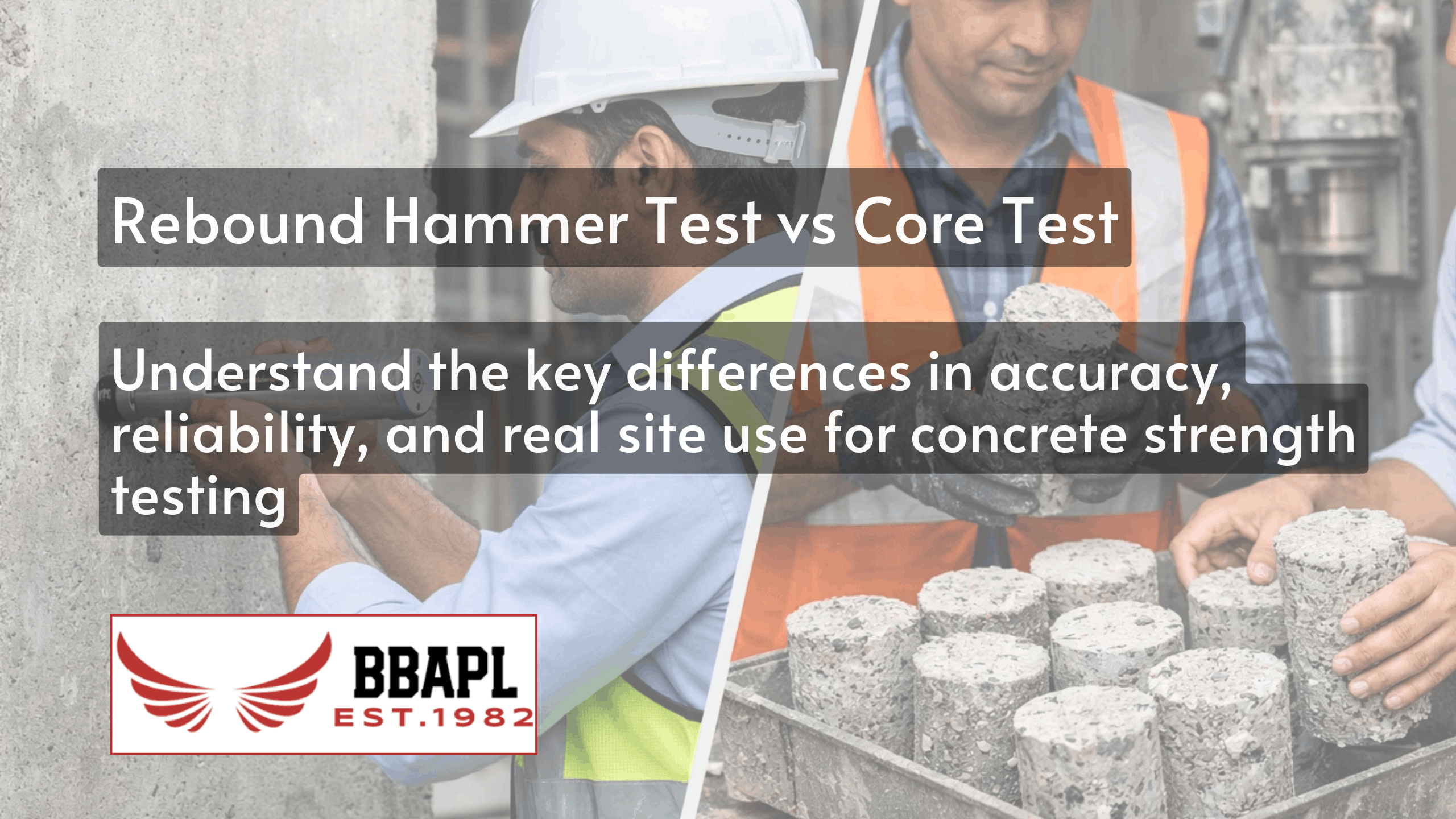
A study was conducted across 450 construction projects, and it was revealed that over 60% of concrete strength disputes stem from reliance on a single testing method (globalgilson). The rebound hammer is often at the center of that conflict.
In cases where the concrete strength of a building is questioned by a building inspector or structural engineer, your test method will make or break when it comes to remediation versus demolition. The concrete strength tests are important in assessing the safety, durability, and conformity of industrial and commercial buildings.
Regardless of whether it is a new plant or an expansion, a structural audit, the engineers need to apply credible testing procedures to determine the performance of the in-situ concrete. The most popular ones are the core cutting test and the rebound hammer test. The knowledge of the difference between the rebound hammer test vs core test assists the stakeholders in making informed decisions that are risk-conscious.
A comparative analysis of rebound hammer and core cutting tests with indicators of difference in accuracy, reliability, and structural impact. It is a snapshot that enables engineers to select the appropriate concrete strength test procedure depending on the requirements of the project.
| Parameter | Rebound Hammer Test | Core Cutting Test |
|---|---|---|
| Test Nature | Non-destructive testing method | Destructive testing method |
| Result Type | Indirect strength estimation | Direct compressive strength |
| Structural Impact | No damage | Minor, repairable damage |
One of the most popular testing procedures that is used on concrete non-destructively is the rebound hammer test. It is used to measure the rebound value of a spring-loaded hammer hitting the concrete. An increase in the level of rebounds is usually a sign of increased hardness of the surface and relative strength.
The test is also quick, cost-effective, and can be used in vast regions, and is therefore best when it comes to pre-tests and determining variation among structural components.
Rebound hammer results are however, affected by surface carbonation, moisture content, finishing quality, and age of concrete. Due to this reason, the test gives an indicative, but not an absolute, measure of strength.
| Aspect | Description |
|---|---|
| Testing Principle | Surface hardness measurement |
| Applicable Standard | IS 13311 (Part 2) |
| Typical Application | Screening and condition assessment |
Core cutting test or concrete cutting test is a test that is conducted through drilling cylindrical samples and subjecting them to controlled laboratory conditions. Having the ability to test real in-situ concrete, the test can be regarded as the most credible one when it comes to testing the strength of concrete.
Core tests are commonly used to check the compliance, resolve a dispute, re-evaluate the load, and perform a safety check.
| Aspect | Description |
|---|---|
| Testing Principle | Laboratory compression testing |
| Applicable Standard | IS 516 |
| Typical Application | Structural audit and validation |
Core cutting tests give direct and laboratory-tested compressive strength values; it is the most dependable method of concrete strength testing. The rebound hammer test provides indicative results that can be used in comparison and screening, but not in determining the final strength.
Non-destructive tests are the best to use in a situation where a quick evaluation is needed. However, it should not compromise the structural functioning or the daily running of the operations.
Rebound Hammer Non-Destructive Testing of the drain raft at JK Tyre & Industries Ltd was done by Bhargava Building Atelier Pvt. Ltd. This was done to determine the strength and homogeneity of concrete without damaging the building.
The tests were conducted in accordance with the NABL and ISO conformant procedures, which are accurate and traceable. The analysis conducted by BBAPL revealed the possible areas of weakness, which allowed the client to make data-oriented decisions.
The current project brings out the significance of rebound hammer testing when carried out in a rigorous manner and is conducive to proactive structural management.
The debate between the rebound hammer test vs the core test is not about choosing one over the other, but about applying the right method at the right time. Rebound hammer testing can be used to note fast and non-destructive assessment and to determine whether further research is necessary.
Nevertheless, in cases where appropriate strength values are required, e.g., structural stability certification, load improvement, or retrofitting, the core cutting test is the most reliable one. After-sales testing is a common practice in industries, whereby rebound hammer testing is used to filter out, and then core testing is used to verify the test.
Rebound hammer and core cutting tests each serve distinct and complementary roles in concrete strength testing. While rebound hammer testing offers speed and non-invasive assessment, core testing delivers precision and certainty. A balanced, engineering-led approach, supported by accredited testing and expert interpretation, ensures safer structures and informed decision-making across industrial and infrastructure projects.
Ensure your structures stand the test of time, book a professional concrete strength assessment today!
📞 Call us: +91-9630150426
✉️ Email: info@bbapl.in
The rebound hammer test is a non-destructive method that estimates concrete strength from surface hardness, while the core cutting test directly measures compressive strength using laboratory-tested concrete samples.
Core cutting tests are more reliable because they provide direct, measurable compressive strength values and are accepted for audits, certifications, and structural safety assessments.
A rebound hammer test should be used for preliminary assessment, condition surveys, and large-area screening where non-destructive testing is required, and rapid results are needed.
Yes, in most cases structural stability certification and load reassessment require core cutting test results, as rebound hammer tests alone are not considered sufficient by authorities.
BBAPL performs NABL-aligned, ISO-compliant non-destructive testing using rebound hammer and other methods to assess in-situ concrete strength and identify risk zones for data-driven decisions.