Quality Managers and QC Heads in large industrial and infrastructure companies are responsible for ensuring consistent, compliant, and audit-ready practices in multiple plants, project/job sites, and laboratories. For companies that operate on a large scale, not having a single standardised Material Testing Standard Operating Procedure (SOP) results in disparate practices, gaps in compliance, and unnecessary delays during the factory licence renewal process.
At Bhargava Building Atelier Pvt Ltd (BBAPL), we have extensive experience working with manufacturers, infrastructure developers, and EPC contractors who face challenges aligning material testing practices across various locations. The best tool for ensuring compliance to a factory’s licence requirements, adherence to safety protocols, and facilitating a smooth renewal process for the factory licence is a clearly defined, centrally managed Material Testing SOP.
Organizations that have multiple sites, and therefore, multiple material test methods, can have many operational and regulatory issues in testing methods. Some of these risks include:
Organizations need to have a standardized Operative Procedure (SOP) to ensure a consistent and system-driven approach to Quality Control (QC) versus a site-based approach.
With a standardized SOP, an organization will be able to demonstrate to the Regulatory Authority that it has the same QC methodology, documentation, and compliance practices.
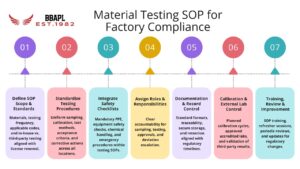
For Quality Managers, the first step is to define the scope of material testing clearly. The SOP should specify:
At BBAPL, we recommend linking each material test directly to factory compliance and license renewal conditions. This ensures that testing activities are not just technically sound but also legally relevant during inspections.
Uniformity is the backbone of an effective SOP. Each test must be documented with clear, step-by-step procedures covering:
Allowing location-specific variations weakens audit defensibility. During factory inspections, authorities often compare practices across multiple units. Any inconsistency can raise questions about overall factory compliance.
Material testing activities are closely linked to workplace safety. A strong SOP must embed safety checklist requirements such as:
Integrating safety elements into the SOP demonstrates that quality testing and safety management function together. This alignment is critical during audits conducted for factory license renewal.
In multi-location operations, a lack of clarity on responsibility often leads to non-conformities. The SOP should define:
Clear accountability strengthens governance and supports regulatory expectations for controlled quality systems.
Testing without proper documentation is equivalent to no testing in the eyes of regulators. A robust SOP must address:
BBAPL often observes that incomplete or inconsistent records are a primary reason for delays in factory license renewal. SOP-driven documentation significantly reduces this risk.
For organizations operating across multiple sites, equipment calibration and third-party testing require strict control. The SOP should specify:
This ensures that all test data, whether internal or external, meets uniform compliance and quality testing benchmarks.
Even the best SOP fails if teams are unaware or untrained. Quality Managers should ensure:
Training documentation often forms part of statutory inspections and strengthens overall factory compliance posture.
Regulatory frameworks, standards, and project requirements evolve. The SOP should include:
A living SOP ensures long-term compliance and reduces last-minute corrective actions during inspections.
At Bhargava Building Atelier Pvt Ltd. (BBAPL), we support organizations by:
Our approach combines engineering expertise with regulatory insight, ensuring SOPs are practical, defensible, and inspection-ready.
To support Quality Managers and QC Heads managing multiple plants and project sites, BBAPL has prepared a practical PDF guide titled “Standardizing Material Testing Across Multiple Locations – A Quality Manager’s Guide”
For Quality Managers and QC Heads, a standardized Material Testing SOP is no longer just a quality document; it is a strategic compliance tool. When designed correctly, it strengthens factory compliance, improves safety checklist adherence, and significantly eases the factory license renewal process.
Organizations that invest in centralized, well-governed SOPs position themselves for smoother audits, consistent quality outcomes, and long-term operational resilience, exactly the outcomes BBAPL helps its clients achieve.
A material testing SOP ensures uniform testing methods, documentation, and safety practices across all locations, which is essential for demonstrating compliance during audits and factory license renewal.
Inspectors look for standardized, documented, and traceable testing processes. A clear SOP proves process control, proper records, and safety compliance, helping avoid delays or objections.
It should define test scope, standards, sampling methods, calibration requirements, safety checklists, documentation formats, and roles to ensure consistent quality and compliance.
By embedding PPE rules, equipment checks, chemical handling, and emergency procedures directly into the SOP, safety compliance is made consistent and verifiable.
At least annually or whenever regulations, standards, or license conditions change to maintain continuous compliance and audit readiness.