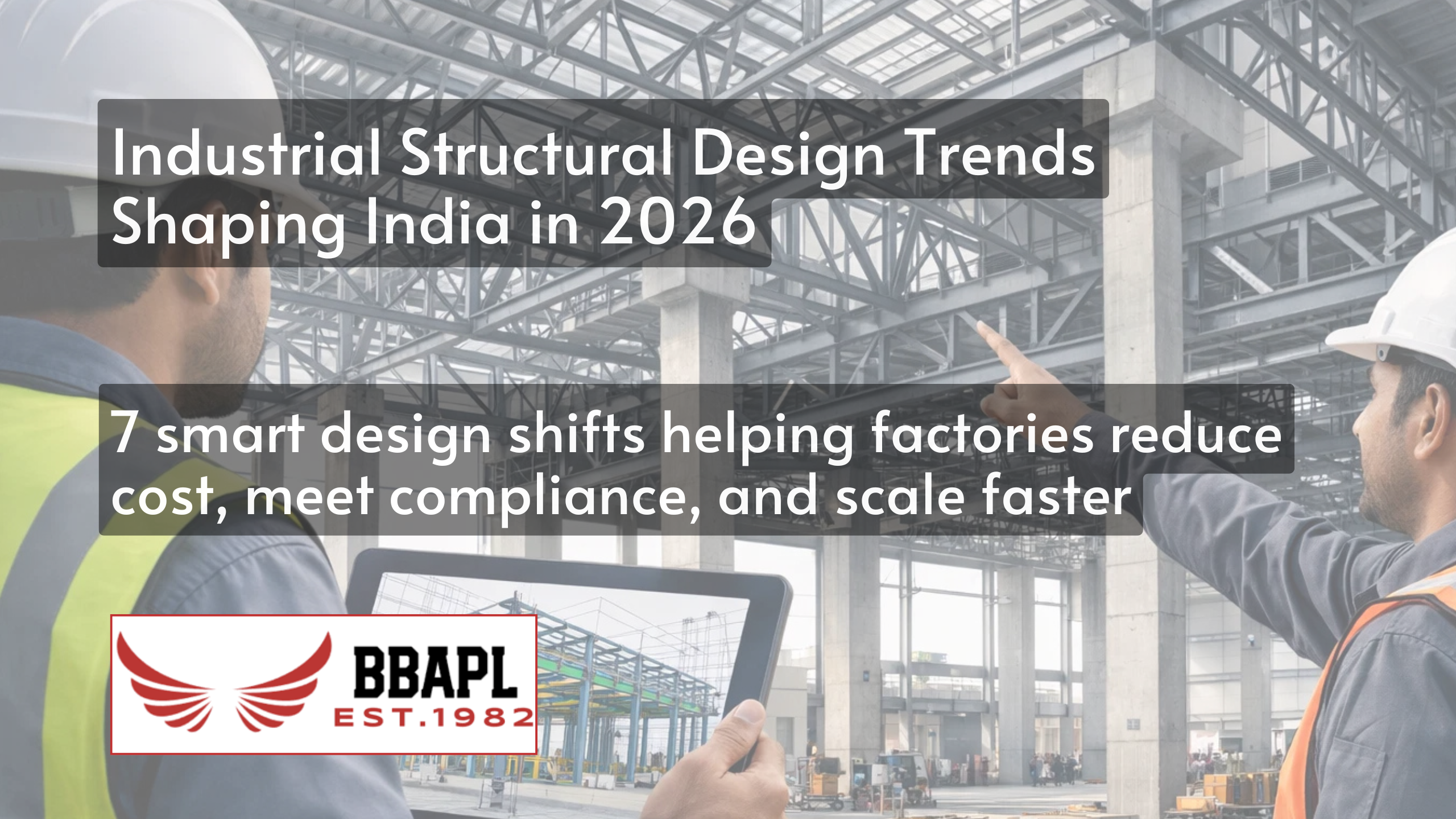
The design of the industrial structures in India is changing at a fast pace. A significant majority of new factory set-ups are taking the pre-engineered and hybrid forms of construction. The owners of a factory must contend with the increased cost of land, the increased compliance standards, and the desire to meet the accelerated timetable.
Check this blog to discover 7 critical design trends that are reshaping how industrial structures are planned, built, and optimized for long-term growth in 2026.
The nature of the industrial project requires more intelligent solutions. The trends in modern design have a direct effect on the project viability and profitability.
Sustainable design not only saves cost but also complies with environmental requirements. Bhargava Building Atelier Pvt Ltd. incorporates the green building practices that provide practical payoff to owners of the factories.
BIM Level 3 creates a single shared digital model accessible to all stakeholders. This collaboration platform transforms project execution.
| BIM Level 3 Feature | Impact on Industrial Projects |
|---|---|
| Single shared model | Eliminates information silos, all teams work from identical data |
| Clash detection | Resolves design conflicts before construction, reduces rework by 30–40% |
| Real-time tracking | Instant updates on changes, improves cost and time control |
| Digital twin capability | Simulates expansions or upgrades before physical implementation |
Resilient design provides both people and investment protection through focusing on site-related environmental and operational hazards. This method increases the lifespan of assets greatly.
Pre-engineered buildings (PEB) and hybrid systems are dominating new industrial construction. These methods balance speed, quality, and cost-effectiveness.
| Structure Type | Key Advantages |
|---|---|
| Pre-Engineered Buildings | 30–40% faster construction, controlled off-site fabrication quality |
| Hybrid Systems (RCC + Steel) | Optimizes structural strength with flexibility, balances cost-effectiveness |
| Warehouse Applications | Quick deployment, easy future expansion, minimal on-site labor |
| Manufacturing Units | Precision assembly, reduced material waste, scalable designs |
Vertical growth maximizes the minimal land area as well as operational efficiency. Smart load planning ensures safety and readiness in future.
Compliance has shifted from checkbox activity to strategic business necessity. Code-compliant designs accelerate approvals and reduce operational risks.
| Compliance Aspect | Business Impact |
|---|---|
| IS codes & NBC alignment | Meets mandatory requirements, ensures structural integrity |
| Statutory approvals | Reduces project delays, speeds up time-to-operation |
| Legal & operational risk | Protects against penalties, accidents, and insurance claims |
| Stakeholder trust | Improves loan approvals, investor confidence, and audit outcomes |
Future ready designs look ahead in the growth and reduce the cost of retrofitting. BBAPL is a data-based planning that enables the scaling of factories to be predictable and affordable.
The success of implementation is reliant on professional instructions and quality procedures. BBAPL offers a full-scale structural consulting for planning and implementation.
The 7 trends that are mentioned above are reshaping the construction industry across India. Sustainable materials, digital tools like BIM, resilient engineering, and compliance-focused design are no longer optional.
Early adoption gives factory owners measurable advantages such as faster project completion, efficient operations, and easier scaling. Bhargava Building Atelier Pvt Ltd (BBAPL) specializes in delivering code-compliant, future-ready industrial structural designs that reduce costs and maximize ROI.
Ready to build a smarter industrial facility? Contact BBAPL today for expert structural consulting and design services tailored to your project needs.
📞 Call us: +91-9630150426
📧 Email: info@bbapl.in
Let BBAPL transform your industrial vision into a structurally sound, future-proof reality.
“`
They include sustainable industrial architecture, BIM Level 3 adoption, resilient factory design, and pre-engineered or hybrid structures.
It enables a single shared digital model, reduces clashes by up to 40%, and improves cost, time, and coordination efficiency.
It lowers operating costs through energy-efficient layouts, supports green certifications, and delivers long-term ROI within 5–7 years.
BBAPL uses data-driven planning, BIM-based coordination, and code-compliant design to support scalability and reduce retrofit costs.
BBAPL delivers compliant, resilient, and cost-optimized structural designs tailored to Indian regulations and long-term growth needs.