Did you know? The global material testing market is projected to reach USD 1,070.9 million by 2030, up from USD 871.9 million in 2025 (marketsandmarkets). The strongest influence on this growth is not demand, but rather the radical transformation in testing methods. In 2026, the process of material testing ceased to be a matter of testing strength.
AI, IoT, and digital automation have stopped being pilot projects, and that is the way that the most successful construction teams and quality heads are operating material assurance nowadays. Here, in this blog, we deconstruct the six material testing trends for 2026 that will shape the industry, what is driving these trends, and what leaders in the construction industry should do today to stay ahead.
According to the Cognitive Market Research data of 2025, the United States led the global future of the material testing market, followed by China, and India occupied the 6th position in the world.
This position is an indication of fast-developing infrastructure, manufacturing, and renewable energy activities in India. This shift is directly influencing demand for construction material testing services in India, where automation, compliance, and digital reporting are becoming baseline expectations.
The rapid industrialization of India is generating powerful opportunities in automation, NDT, digital lab systems, and sustainable material validation.
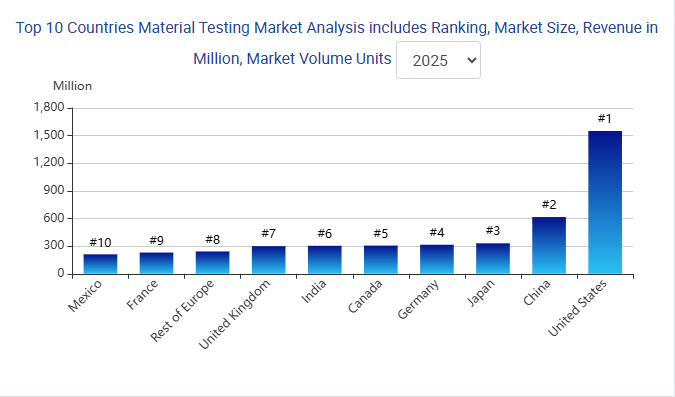 Source: cognitivemarketresearch
The use of AI-based testing systems is minimizing human reliance on interpretation, reporting, and anomaly detection. Even more importantly, now machine learning models are studying past data on the strengths and predicting possible patterns of failure before they can be seen.
Portable testing equipment is changing the manner in which quality assurance is being conducted. Engineers are now even doing strength/integrity checks on-site rather than waiting to receive a centralized report from the lab.
| Traditional Lab Model | Portable Testing Model |
|---|---|
| Sample transported to the lab | Testing conducted on-site |
| 2–7 day report cycle | Same-day preliminary result |
| Higher indirect cost | Time & cost efficient |
UPV equipment, portable rebound hammers, and soil testing kits are becoming a common way of keeping projects on time in the Indian construction testing automation environment.
Laboratory Information Management Systems (LIMS), IoT-enabled testing devices, and cloud-based dashboards are replacing paper registers and manual reporting.
The use of digital minimizes the gaps and enhances responsibility in project lifecycles.
The sustainability validation is no longer an optional certification but now an obligatory contract clause of the renewable infrastructure and large-scale infrastructure project.
BBAPL has also elaborated on how BIS norms, NABL-accredited labs, and PARIVESH 2.0 compliance shape industrial soil testing in 2026 in its dedicated guide on Soil Testing and Soil Investigation for Industrial Projects in 2026.
Traceability provides the ability to trace all the samples, which have been tested since their collection, up to reporting, to form a legally defensible documentation.
The accreditation ceases to be a quality indicator. In 2026, NABL testing trends are becoming mandatory for government projects and high-value private sector contracts. Making a selection of an NABL-accredited material testing lab in MP and across India is a strategic necessity rather than a preference.
Also Check: IS Codes for Material and Soil Testing as per BIS & NABL Standards in MP
Failure to modernize in 2026 can result in tender disqualification, delayed approvals, higher rework costs, insurance disputes, and declining client trust. In today’s compliance-driven infrastructure landscape, standing still is a competitive disadvantage.
To stay ahead, construction and QA leaders must integrate digital LIMS systems. It expands NABL accreditation scope, partners with automation-ready labs, enforces end-to-end traceability, and embeds sustainability validation into material approval processes. Testing strategy is now directly linked to project risk management.
Material testing is becoming a strategic control point across engineering, procurement, and quality functions. With AI automation, digital workflows, sustainability mandates, and stricter NABL norms rising, data-driven testing will define project speed and compliance.
Infrastructure leaders who treat testing as a strategic advantage, not just a requirement, will reduce risk, accelerate approvals, and strengthen long-term project credibility. As a provider of construction material testing services in India, BBAPL delivers infrastructure quality testing services with NABL-aligned systems and advanced digital documentation.
📞 Partner with BBAPL to strengthen your project from the ground up.
Call: +91-9630150426
Email: info@bbapl.in
As a provider of construction material testing services in India, BBAPL ensures compliance, quality assurance, and digital transparency for modern infrastructure projects.
Material testing trends in 2026 focus on AI-driven analysis, testing automation, digital workflows, sustainability checks, traceability, and stricter NABL procurement norms.
Construction testing automation reduces manual errors, speeds up test-to-report cycles, integrates with ERP systems, and supports real-time compliance tracking for large infrastructure projects.
Digital material testing enables LIMS integration, cloud reporting, calibration tracking, and audit-ready records, reducing legal risk and boosting tender transparency.
NABL testing trends are shifting accreditation from a quality differentiator to a mandatory requirement in infrastructure tenders, especially for government and PSU projects.
The future of material testing in India is driven by renewable energy expansion, mega infrastructure programs, predictive analytics, and compliance-heavy procurement models.
Sustainability testing now includes carbon footprint validation, durability analysis, and climate stress testing, making it a contractual requirement in renewable and urban projects.
End-to-end digital traceability ensures legally defensible documentation, protects against structural claim disputes, and strengthens vendor qualification processes.
BBAPL integrates digital material testing practices, NABL-aligned processes, and structured documentation systems to support compliance-driven infrastructure projects.
No related posts found.