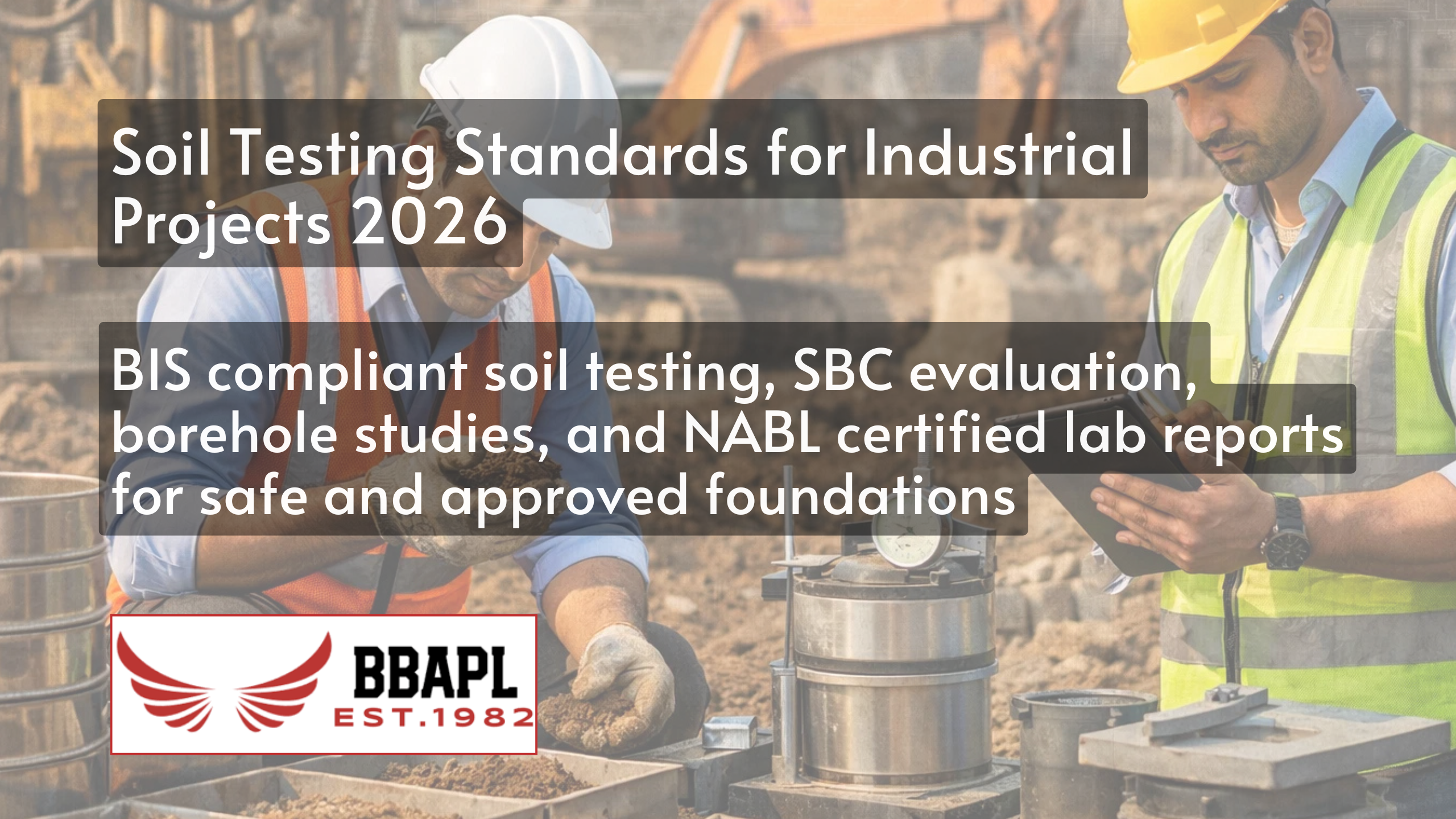
The construction industry in India is projected to reach ₹5.31 lakh crore by 2026, growing at 11.2% annually (GrandViewResearch). With rapid industrial expansion and infrastructure development, soil testing for construction has become a critical first step, not just for compliance, but for safety, cost control, and long-term performance.
Accurate geotechnical soil testing helps reduce structural risks, speeds up approvals, and ensures reliable foundation design.
Soil testing in construction refers to the analysis of soil properties to determine its suitability for building structures. It is a core part of soil investigation for construction and falls under geotechnical engineering.
Before the establishment of a foundation, engineers use geotechnical soil testing to explain the behavior of soils under loads. This involves determining the strength, composition, moisture content, and bearing capacity.
An average laboratory of soil testing undertakes field tests as well as lab tests so as to produce the right type of data. These results are then used to design safe and cost-efficient foundations for industrial projects.
Professional soil investigation services will guarantee:
Without proper soil testing, even well-designed structures can fail due to weak or unstable ground conditions.
Industrial work is characterized by heavy loads, massive structures, and long work hours. Disregard of soil testing may cause severe risks, including:
For industrial projects, soil conditions can vary significantly across the site. Proper testing ensures that the design accounts for these variations, reducing future risks and maintenance costs.
A structured soil investigation process improves both accuracy and project efficiency.
Initial inspection of the land to understand topography, drainage, and soil conditions.
Collection of soil samples from different depths using boreholes or excavation methods.
On-site tests such as:
These help assess real-time soil strength.
Samples are analyzed in certified labs to determine:
A detailed report is prepared including:
This report is essential for structural design and approvals.
Industrial projects use both field and lab tests to understand soil behavior and design safe foundations.
The Bureau of Indian Standards (BIS) governs soil testing practices in India through key codes:
These standards ensure:
Adhering to BIS standards is mandatory for industrial and infrastructure projects.
The issue of cost is critical in decision-making since it has a direct influence on the budgeting of projects and the financial planning at the first steps.
The prior awareness of the soil testing costs is useful in avoiding unnecessary costs, as well as ensuring appropriate allocation of resources during the project lifecycle.
| Project Type | Soil Testing Cost |
|---|---|
| Residential | ₹5,000 – ₹15,000 |
| Commercial | ₹20,000 – ₹50,000 |
| Industrial Projects | ₹50,000 – ₹2,00,000 |
It is very important to choose the right lab to obtain correct results.
Testing should be conducted in NABL-accredited laboratories certified by the National Accreditation Board for Testing and Calibration Laboratories.
Early detection of soil problems helps in making the appropriate foundation solution. Industrial sites often face these complex soil challenges:
Environmental compliance is closely connected to soil testing since projects are expected to adhere to the Environmental Impact Assessment (EIA) standards. Approvals must be obtained via the PARIVESH 2.0 portal.
This is done by the establishment of baseline soil data, seasonal monitoring, and performing testing using certified labs. Proper documentation of these requirements not only ensures regulatory compliance but also helps in faster approvals and prevents potential legal delays.
Soil testing is rapidly evolving with advancements in technology and modern methods. Techniques such as drone-based site surveys, digital soil mapping, and AI-driven geotechnical analysis are becoming increasingly common.
These innovations significantly improve accuracy, reduce the time required for investigations, and enable better decision-making for large industrial projects.
Soil testing is no longer optional, it is the foundation of safe and successful industrial construction. From soil investigation services to advanced testing methods, every step plays a critical role in ensuring structural integrity and compliance.
By following BIS standards, using certified labs, and adopting modern technologies, industrial projects can minimize risks, control costs, and build with confidence.
For reliable soil testing and geotechnical support, connect with BBAPL today.
📧 Email: info@bbapl.in
📞 Phone: +91-9630150426
🌐 Website: www.bbapl.in
Soil testing ensures that the ground can safely support the proposed structure without risk of failure. It also helps engineers design the most suitable and stable foundation system.
The Standard Penetration Test (SPT) is one of the most commonly used field tests in construction projects. It helps determine soil strength and provides key data for foundation design.
Soil testing typically takes around 7–15 days depending on the project size and complexity. Larger industrial projects may require additional time due to extensive fieldwork and lab analysis.
Yes, soil testing is mandatory for most industrial and infrastructure projects in India. It is required to comply with BIS standards and environmental regulations before construction begins.
Yes, soil testing helps identify potential issues early, reducing the risk of costly design changes later. It also prevents structural failures, saving long-term repair and maintenance costs.


Talk to Our Experts Today — We're just a call or message away.

Already a member? Sign in now