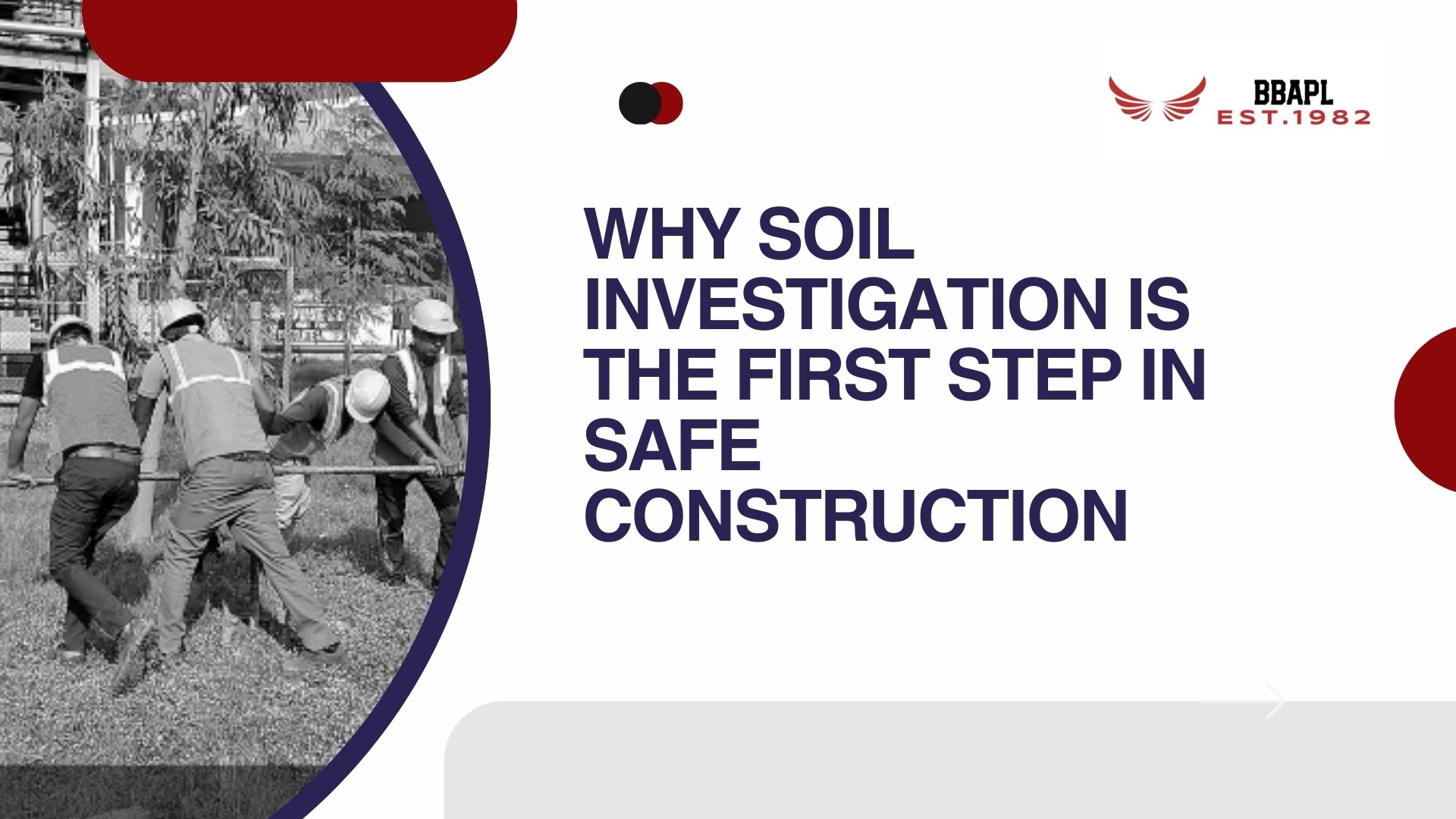
Soil testing is one thing that you cannot overlook before you break ground on any construction project. With the Indian construction industry developing at a rapid pace, the soil testing segment is projected to grow at an 8.2% CAGR between 2026 and 2030 (pib.gov.in). Consequently, the significance of accurate ground investigation has never been more pronounced. Regardless of whether you are constructing a residential complex, an industrial, or a commercial place, you need to know what is under your site before concluding foundation design.
This blog will discuss the importance of soil testing and the most important tests that you should have, such as bearing capacity, compaction, moisture content, and strength tests. A correct soil investigation will assist you in preventing settlement, structural cracks, and expensive failures in the future.
The foundation design, in reality, is based on soil testing. Without proper analysis, you are building on assumptions that can risk safety, stability, and long-term performance.
Also Read: Soil Testing and Soil Investigation for Industrial Projects in 2026
Timing is important when it comes to soil testing. Carrying out investigations at the appropriate stage assists you in lowering the risk, maximizing design choices, and preventing future unpleasant surprises.
Understanding which soil test for building a foundation is required ensures comprehensive analysis and informed decision-making.
This test determines the maximum load soil can safely support without failure or excessive settlement. Methods like the Standard Penetration Test (SPT) and Plate Load Test help define safe bearing capacity, guiding foundation depth and design. It is one of the most critical soil tests for foundation construction.
The major analyses of this test are:
Particle size distribution and Atterberg limits testing help:
Standard proctor or modified proctor tests prove essential in:
This test, especially in clayey soils, was:
The tests of soil chemistry include:
Also Check: BBAPL’s Material Testing Services
Proper soil testing for construction helps engineers select the safest and most cost-effective foundation system based on bearing capacity, moisture, compaction, and strength results from soil investigation tests.
At Bhargava Building Atelier Pvt Ltd., we deliver reliable, data-driven soil and material testing solutions that strengthen foundation design and structural safety. With decades of expertise and certified systems, we ensure accuracy, compliance, and long-term performance.
Project: Foundation design for new industrial chimney
Scope of Work:
Outcome:
Testing Conducted:
Results:
Methodology: Rebound Hammer Test for non-destructive assessment
Key Benefits:
Soil testing is not a cost, it’s an investment in structural integrity, safety, and long-term savings. Skipping soil investigation tests risks settlement, structural damage, and financial loss.
Planning a construction project in Madhya Pradesh? Book a professional soil investigation with BBAPL today and build on verified ground data, not assumptions.
The cost of soil testing for construction depends on borehole depth, number of samples, and laboratory tests required. On average, it ranges between ₹15,000 and ₹50,000 for small to mid-sized projects.
Each city has distinct soil characteristics and water table behavior, making site-specific soil investigation critical for long-term structural stability.
Yes. In Bhopal, varying soil strata and groundwater levels make geotechnical investigation essential for safe foundation design.
Skipping soil testing can result in uneven settlement, structural cracks, tilting, foundation failure, and costly repairs.
Common tests include bearing capacity, soil classification (Atterberg limits), compaction test, consolidation test, and chemical analysis.
High moisture levels can reduce soil strength, cause swelling in clay soils, and lead to long-term foundation damage.
It is a test (like SPT or Plate Load Test) that determines how much load the soil can safely support without failure or excessive settlement.
Soil testing should be done before land purchase, during planning and design, and definitely before foundation excavation begins.
Soil testing determines bearing capacity, settlement potential, and stability, ensuring safe and cost-effective foundation design.
No related posts found.