It is important to ensure the structural stability of your building before you occupy, sell, or renovate your property. A structural stability certificate indicates that your building is safe, healthy, and capable of supporting all intended daily loads and environmental-induced forces on the structure, which protects investments as well as the health and safety of people.
In response to recent building collapses and tightened safety audits throughout India, the need for obtaining a certified structural stability audit has increased significantly. In an evolving city like Gwalior, where heritage buildings co-exist with modern buildings, this certification is becoming a requirement to protect against risk.
BBAPL has licensed structural engineers that are trained in structural audits and certified and accredited testing facilities in accordance with NABL members, and offers full end-to-end independent structural audits and certification report services that will ensure your building complies with mandated safety norms and will provide structural reliability for many years.
A structural stability certificate (often referred to as a building stability certificate) is the formal documentation provided by a qualified structural engineer after performing a thorough investigation of your building. It certifies that,
The certificate adheres to the National Building Code (NBC) and IS code formation, allowing the document to stand as formal and legally accepted in establishing a suitable condition for the building.
Local municipal and urban planning departments rely on this certification of structural stability when authorizing occupancy clearance, as well as for renewal and clearance for renovations, to have an assurance that a building is deemed safe for occupancy or use if the building is structurally stable.
Read more: BBAPL Lab Management Solution
You’ll need a structural stability certificate whenever a building’s safety, integrity, or compliance must be verified, whether it’s new, renovated, or ageing.
Moreover, it is also mandatory for industrial factories and warehouses under the Factories Act and for obtaining the Chief Inspector of Factories (MP) so that workers and structures are safe.
Furthermore, multi-story and institutional buildings typically require re-certification every 5 years in compliance with local by-laws.
Simply put, it is a safety certificate for your building so it doesn’t fall down unexpectedly or injure any of its occupants. Certified and trustworthy structural engineers in Gwalior are an important part of the process in completing the assessments.
A structural stability certificate isn’t just about compliance; it’s about safety, trust, and legal assurance. In a city like Gwalior, where heritage and modern buildings coexist, timely certification safeguards lives and properties.
| Purpose / Benefit | Why It Matters |
|---|---|
| Safeguards Human Life | Detects hidden issues like cracks, corrosion, or weak foundations before they become life-threatening. Also helps property owners avoid legal liability during accidents or structural failures. |
| Crucial for Property Deals | Builds trust for buyers, sellers, and tenants. Simplifies loan processing and can improve insurance terms. |
| Post-Disaster Safety Check | Identifies internal damage after earthquakes, floods, or storms to ensure continued safety of use. |
| Aging Building Assessment | Many Gwalior buildings over 25 years old show hidden wear. BBAPL’s certified audits help detect and fix issues early. |
| Legal Requirement | Mandated by Gwalior Nagar Nigam, PWD, and Industrial Area Development Authority (IADA) for building permissions, renovations, or commercial licenses. Non-compliance may lead to fines, permit cancellations, or demolition orders. |
Getting a structural stability certificate involves more than just paperwork. It’s a technical, step-by-step process that ensures your building is safe, sound, and compliant.
| Step | Description |
|---|---|
| Site Inspection | Visual assessment for cracks, sagging, water damage, and other visible irregularities. |
| Blueprint Verification | Cross-checking approved architectural and structural drawings with on-site construction. |
| Structural Testing | Use of non-destructive testing (NDT) methods like ultrasonic pulse velocity and rebound hammer tests to measure concrete strength without damaging the structure. BBAPL employs advanced NDT tools to ensure precision and reliability. |
| Soil Testing (if required) | Evaluates the soil’s bearing capacity to confirm foundation stability. |
| Detailed Report | A comprehensive report covering structural integrity, safety observations, and required repairs, along with digital inspection records and photographic evidence for complete transparency. |
At the beginning of obtaining a structural stability certificate, you may be asked to provide:
Please note that the required documents may differ by project type: residential, commercial, or industrial, as each project has its own safety concerns and regulatory standards.
BBAPL’s team can help clients collect the needed documentation and submit them accordingly and communicate with the NABL accredited construction labs located in Gwalior for any building materials or structural tests, if identified, necessary for the certification process.
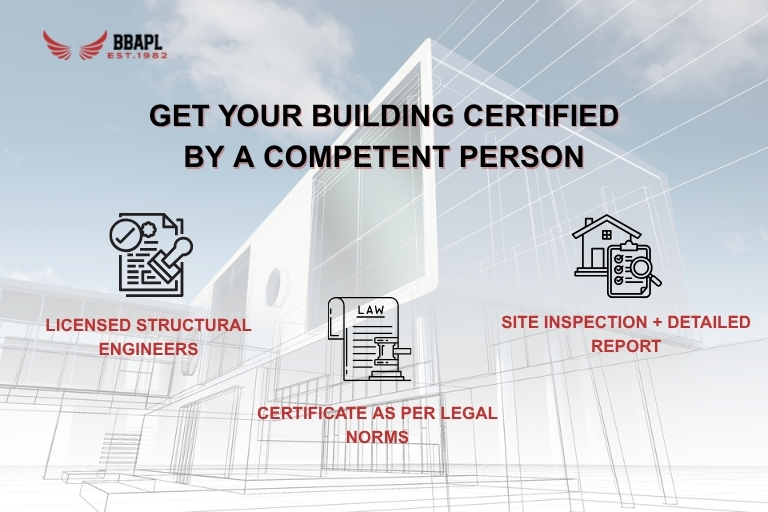
A legitimate building stability certificate may only be issued by a certified structural engineer or a registered engineering firm. The engineer should:
Note: The building stability certificate has to be stamped and signed by the licensed structural engineer. Certificates from architectural design firms or contractors are not legal and will cause compliance problems and/or legal penalties.
BBAPL’s team of licensed structural engineers are on local and state department panels so that all reports and certificates we prepare are legal and technically valid.
Before a new structure is occupied, after major renovations, or after a natural disaster, a structural stability certificate is required. It is also important to have a structural stability certificate for old buildings, during property sales, or when applying for a commercial license.
You will need a structural stability certificate in the following instances:
Note: To be legally valid, the structural stability certificate must be stamped and signed by a licensed structural engineer, not an architectural firm or contractor or a person with no structural engineering qualifications.
BBAPL’s structural engineers are empanelled with various local and state authorized departments and issue reports and certificates with complete legal and technical weight. This allows owners the confidence that their buildings comply with required codes.
Failing to have a structural stability certificate places your property in significant danger of legal, financial, and safety disadvantages. This could result in structural failures, liability claims, and not receiving approvals for resale, leasing, or occupation.
Today, most property and fire insurance providers will require a current structural stability certificate in their risk assessment processes. Once a property doesn’t have a certificate you could expect a claim to be denied, even after regular payments.
For example, in 2024, multiple buildings in multiple municipalities across Madhya Pradesh were denied occupancy clearances due to a missing or expired stability audit report. This shows just how commonplace obtaining certification on time has become.
At BBAPL, we are a certified engineering firm based in Gwalior and supported by licensed structural engineers, with more than 40 years of experience. We provide structural stability certificates, structural audits, and building safety certifications for all types of properties in Gwalior and Pan India.
Whether it’s a new building, an existing structure, or a proposed remodeling, we make your building 100% safe, compliant, and ready for occupancy.
With 40+ years of experience and trusted services, our licensed experts provide professional structural stability certification in Gwalior, making your building safe, compliant, and ready for occupancy.
+91 96301-50426 Book your inspection
A structural stability certificate is generally valid for 3 to 5 years, depending on the building’s type, age, and condition. For industrial or high-rise structures, the validity may be shorter as per local municipal or factory department norms. After this period, a re-inspection is required to renew the certification.
Before certification, engineers conduct several non-destructive and visual assessments, such as: 1. Ultrasonic Pulse Velocity (UPV) Test 2. Rebound Hammer Test 3. Core Cutting Test (if necessary) 4. Soil Bearing Capacity Check 4. Visual audit for cracks, corrosion, or settlement These tests ensure that the building’s materials and structure meet safety standards.
The cost varies depending on building size, purpose, and testing scope. For reference: 1. Residential buildings: ₹5,000–₹15,000 2. Commercial/industrial units: ₹20,000–₹1,00,000+ Projects involving detailed NDT or soil testing may have additional charges.(BBAPL provides transparent, customized quotations after reviewing your site details.)
To obtain one, follow these steps: 1. Hire a licensed structural engineer or authorized firm (such as BBAPL). 2. Submit building drawings and previous audit reports (if any). 3. Allow site inspection and testing. 4. Receive the certified report, stamped and signed by the engineer. Note: Certificates issued by contractors or non-licensed professionals are not legally valid.
You can check a building’s stability by: 1. Scheduling a visual inspection from a certified engineer. 2. Performing periodic NDT tests to assess concrete and reinforcement quality. 3. Reviewing the latest stability certificate for expiry and remarks. Regular inspections (every 3–5 years) help maintain compliance and prevent unexpected failures.