India’s cities are ageing faster than most people realize. Structural collapses in India killed 8,756 people in the last few years, roughly five lives lost every single day. Behind nearly every one of those tragedies is a building that was never formally re-assessed, a deterioration process that went undetected, and a risk that could have been identified and addressed in time.
If you own, manage, or are responsible for a building that is 15 years or older, this guide is for you, whether you oversee a commercial complex in Mumbai, an industrial facility in Pune, a housing society in Chennai, or a government building anywhere across India. The question is not whether your building will show signs of structural ageing. The question is whether you will identify them before they become irreversible.
A structural re-assessment is a detailed engineering evaluation that checks whether an existing building remains safe and structurally sound as it ages. Over time, factors like weather exposure, material deterioration, increased loading, and unauthorised modifications can affect structural performance.
The process typically includes site inspections, testing methods, structural analysis, and engineering review to identify hidden risks before they develop into major safety concerns. For buildings that are 15 years or older, a professional re-assessment helps owners make informed decisions about maintenance, strengthening, or repairs.
The 15-year mark is where multiple deterioration processes, many of them invisible, begin to converge in ways that meaningfully compromise structural safety.
Over time, moisture and air can slowly weaken concrete and cause steel bars inside to rust. In coastal and humid areas, this process happens faster, often without visible warning signs.
Year after year, rain, water seepage, temperature fluctuations, and seismic activity create small cracks that can gradually weaken a building’s structural integrity.
Adding extra floors, removing walls, or changing columns without proper assessment can put stress on a structure in ways it was never designed for.
When spaces are repurposed or heavy equipment is added, buildings may face loads beyond their original design capacity.
Older buildings can have hidden weaknesses due to material quality or construction practices. Early testing and assessment help identify risks before they become major issues.
Neglecting a structural re-assessment is not a passive decision, it is an active accumulation of risk. Progressive structural failure is the engineering reality: unmonitored cracks escalate through successive monsoon cycles until load-bearing capacity is compromised.
Legal and compliance exposure follows, municipal penalties, demolition orders, and occupancy revocation under state bye-laws and RERA are no longer theoretical outcomes. Financial liability compounds with every deferred inspection, while reputational risk and life safety responsibility sit with every building owner, regardless of regulatory pressure.
Engineering standards recommend a comprehensive assessment at 15 years, with mandatory or advisory re-assessments at 20, 25, and 30-year intervals thereafter. CPWD guidelines and state-level building bye-laws, Maharashtra, Delhi, Karnataka, Tamil Nadu, support these intervals, and many municipal corporations have already issued formal directives requiring structural safety certificates for buildings beyond a specified age.
Certain events must immediately initiate a formal structural audit old buildings India process:
Certain events must immediately initiate a formal structural audit old buildings India process: visible diagonal or settlement cracking, any seismic activity in the region, major flood or waterlogging exposure, before any new floor addition, after fire damage, any change of building use, property acquisition due diligence, and before occupancy certificate or fire NOC renewals.
A structural audit combines engineering inspection, testing, and technical evaluation to assess the condition and safety of a building.
The process generally includes:
• Visual inspection of structural elements and distress signs
• Non-destructive testing to assess material condition
• Structural load and capacity evaluation
• Foundation and soil assessment where required
• Review of drawings and building modifications
• Engineering analysis to determine safety and future requirements
Based on findings, engineers may recommend maintenance measures, structural strengthening, retrofitting, or certification if the building meets required safety standards.
Systematic on-site crack pattern mapping distinguishing flexural, shear, and settlement cracks; assessment of spalling concrete and exposed reinforcement; documentation of efflorescence, waterproofing degradation, and drainage conditions.
Estimating in-situ compressive strength.
Detecting internal voids and concrete uniformity.
Measuring probability and extent of rebar corrosion.
Actual compressive strength from extracted samples.
Measuring atmospheric carbonation penetration depth.
All laboratory testing at BBAPL is performed in accordance with NABL-accredited protocols, ensuring that every result is precise, traceable, and accepted by statutory authorities across India.
BBAPL engineers use STAAD Pro, ETABS, and SAFE to reassess current loads against original design capacity, critical for multi-storey commercial buildings and industrial structures where usage has changed since construction.
Sub-surface investigation, borehole data review, and geotechnical evaluation assess foundation integrity, BBAPL’s 100+ geotechnical test coverages bring the same rigour to the ground beneath a structure as to the structure itself.
Millions of Indian buildings predate IS 1893:2016 and NBC 2016 seismic provisions. Re-assessment evaluates lateral load capacity, column-beam ductility, shear wall presence, and foundation suitability for seismic events.
Systematic comparison of as-built conditions against original approved drawings regularly uncovers deviations, unauthorised additions, removed load-bearing elements, changed structural spans, that directly and materially affect structural safety.
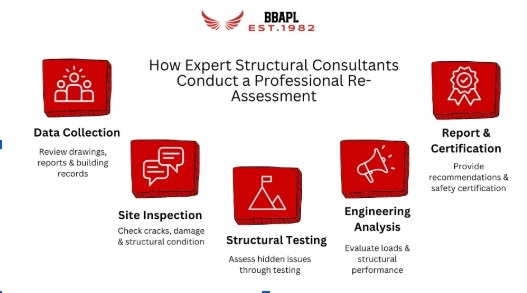
Review of original structural drawings, soil investigation reports, construction completion certificates, previous inspection records, and the full occupancy and modification history.
Qualified structural engineers systematically map all distress indicators, cracking patterns, material degradation, drainage issues, and visible loading changes.
NDT deployment and, where warranted, controlled destructive sampling, all under NABL-accredited protocols, producing legally and technically defensible results.
Load reassessment using STAAD Pro, ETABS, and SAFE updated with current site data. Seismic analysis under IS 1893. Full comparison against NBC 2016 structural provisions.
Comprehensive technical report covering structural condition grading, risk zones, and specific remediation recommendations, strengthening, retrofitting, or formal intervention advisory.
Where the structure is confirmed safe, or following successful remediation, BBAPL issues a Structural Stability Certificate, critical for statutory submissions, occupancy renewals, insurance, and legal protection.
NBC 2016 Part 6 establishes the framework for periodic structural safety review of existing buildings. IS 456:2000, IS 13920:2016, IS 1893:2016, and SP 24 collectively form the technical compliance standard every professional assessment must address.
Municipal corporations across Mumbai, Delhi, Pune, Chennai, and Hyderabad have issued formal directives mandating structural safety certificates for buildings typically between 15 and 30 years old. Non-compliance invites occupancy revocation, demolition notices, and significant legal liability.
Structural assessments are increasingly required in property transactions, insurance renewals, RERA due diligence, and infrastructure financing by banks and NBFCs, creating simultaneous regulatory, financial, and legal exposure for owners who lack certified assessments.
A building can look perfectly fine on the outside and still have structural issues developing inside. Problems like internal steel corrosion, concrete deterioration, carbonation, or tiny cracks often build up slowly over time without obvious warning signs.
A quick visual check can identify visible damage, but it cannot reveal what is happening beneath the surface. Professional structural assessments use engineering evaluation and testing methods to understand the actual condition of a building, from material strength to structural performance.
As buildings get older, face years of weather exposure, or go through changes in usage, these assessments help identify concerns early, when repairs are usually simpler, safer, and more manageable.
Structural Stability Certificate issued. Maintenance recommendations and a future re-assessment schedule provided. Certificate valid for insurance, compliance, and property transactions.
Engineering drawings prepared for jacketing, grouting, underpinning, or shear wall additions using STAAD Pro, AutoCAD, and SAFE. Construction supervision available through BBAPL’s structural design team.
In severe cases, a formal advisory is issued. This is precisely what proactive re-assessment prevents, problems identified at 15 years are almost always remediable. Identified after 30 years of unmonitored deterioration, options narrow significantly and costs multiply.
Structural safety works best as a preventive process rather than a reactive one. As buildings age, weather exposure, material deterioration, and changing usage can gradually affect structural performance.
For buildings that are 15 years or older, timely structural assessment helps identify concerns early and supports safer long-term performance.
If your building is 15+ years old, has visible distress signs, or has undergone modifications, consider a professional structural assessment.
Contact BBAPL: +91-9630150426 to discuss your structural audit requirements.
Yes. Construction defects, design issues, settlement, cracking, or early distress signs may require a structural assessment before 15 years.
Yes. A Structural Stability Certificate can improve buyer, tenant, and lender confidence during property transactions.
Most structural re-assessments take around 2 to 4 weeks, depending on building size and testing requirements.
Some banks and financial institutions may request structural safety reports for older properties before loan approval.
Yes, but independent structural consultants are often preferred for unbiased evaluation.
Yes. Reports usually classify buildings based on condition, repair needs, and structural risk level.
No. Structural assessments focus on foundations, columns, beams, slabs, and overall structural integrity.


Talk to Our Experts Today — We're just a call or message away.

Already a member? Sign in now