Every monsoon season, attention shifts to leaking roofs, waterlogged roads, and damaged interiors. But the more serious threat often goes entirely unseen, beneath the ground, beneath the slab, beneath the very base of your building. The decline in soil bearing capacity during monsoon is often overlooked, even though excessive rainfall can severely weaken the soil supporting a structure.
Monsoon rainfall does not just affect visible surfaces. It fundamentally alters soil behaviour. And when soil behaviour changes, foundations become vulnerable. Increased moisture content and soil saturation reduce the soil’s ability to safely carry structural loads, leading to settlement, cracks, and long-term foundation instability.
According to a Centre for Science and Environment (CSE) report, extreme weather events during India’s monsoon season destroyed over 2,35,000 houses and buildings in a single year, with Madhya Pradesh among the most severely impacted states. Reduced soil bearing capacity during the monsoon is one of the most underestimated structural risks in Indian construction.
Excessive rainfall triggers settlement, cracking, seepage, and long-term structural distress, often without visible warning until serious damage has already occurred.
Heavy monsoon rainfall weakens soil by increasing moisture content, reducing internal friction, and reducing the soil bearing capacity during monsoon conditions.
Soil strength is highly dependent on moisture levels, compaction, and drainage conditions. During the monsoon, rainwater seeps into the gaps between soil particles, increasing soil saturation and making the soil softer and less stable. As internal friction reduces, the soil loses its ability to safely support structural loads.
This problem becomes more critical in areas with continuous rainfall or inadequate drainage systems. Over time, water accumulation around the foundation zone further weakens the soil, increasing the risk of settlement, cracks, and foundation instability.
Foundations are designed based on the expected strength of the supporting soil. But saturated soil behaves very differently from dry, compacted ground.
As soil absorbs excessive moisture, it loses stiffness and begins to deform under structural loads. This creates uneven support conditions beneath the foundation. Over multiple monsoon cycles, the condition worsens progressively.
The soil saturation impact on foundations may not always be visible immediately, but structural stress continues developing below ground level long before cracks appear above it.
Not all soils behave the same during rainfall. The risk depends heavily on soil type, compaction quality, and site drainage.
| Soil Type | Behaviour During Monsoon | Impact on Foundations |
|---|---|---|
| Clayey Soil | Absorbs water quickly and expands during the monsoon. | Expansion creates upward pressure beneath foundations and plinth areas. Repeated expansion and shrinkage cycles after drying gradually weaken structural stability. |
| Sandy Soil | Drains faster than clay, but performance depends on compaction. | Poorly compacted sandy soil may lose support due to erosion or continuous water flow around foundation edges, leading to instability. |
| Black Cotton Soil | Highly expansive soil with strong swelling and shrinkage cycles during moisture changes. | Causes severe stress on foundations, flooring, and walls. Particularly risky in regions like Madhya Pradesh and Central India. |
| Filled-Up Land | Highly unpredictable due to uneven compaction and mixed material composition. | Heavy rainfall causes water infiltration, weakening loose layers and increasing settlement risks without clear warning signs. |
Clayey Soil absorbs water quickly and expands during the monsoon. This expansion creates upward pressure beneath foundations and plinth areas. Once the soil dries, it shrinks again. Repeated expansion and shrinkage cycles gradually weaken structural stability.
Sandy Soil drains faster than clay. However, poorly compacted sandy soil may lose support through erosion or continuous water flow around foundation edges.
Black Cotton Soil is highly expansive and particularly vulnerable during monsoon. Its swelling and shrinkage cycles create severe stress on foundations, flooring, and walls. This soil type is widespread across Madhya Pradesh and Central India, making it a significant regional concern.
Filled-Up Land carries the highest unpredictability. Buildings constructed on filled land without proper compaction face elevated settlement risks during heavy rainfall. Water infiltration weakens loose soil layers and reduces bearing performance in ways that are difficult to predict without investigation.
When soil loses its load-bearing capacity, the foundation above it begins to move unevenly.
This is called differential settlement. It happens when one portion of the foundation settles more than another due to inconsistent soil conditions beneath the structure. The building experiences imbalanced stress, and the effects begin showing above ground.
Common indicators include:
Older buildings face compounded risk. Many were designed under different site conditions and loading assumptions. Over time, additional floors, equipment loads, nearby excavation, or drainage changes increase stress on the original foundation system. Heavy monsoon rainfall accelerates these pre-existing weaknesses.
Foundation problems rarely appear suddenly. Most structures show early symptoms long before major damage occurs. Recognising them early is the difference between a preventive intervention and a costly structural repair.
Watch for:
These signs may appear minor. But they often indicate deeper foundation stress caused by weakening soil conditions below.
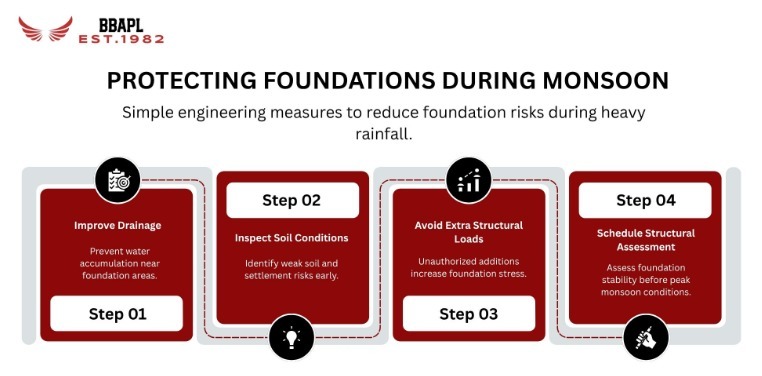
A professional engineering assessment before peak monsoon identifies hidden risks while intervention is still straightforward. For industrial facilities, commercial buildings, residential societies, and structures on expansive soil, this typically includes soil condition assessment, foundation inspection, structural distress mapping, settlement observation, drainage evaluation, and moisture impact analysis.
Monsoon affects far more than visible structural surfaces. Excess rainfall weakens soil strength, reduces bearing capacity, and increases the risk of foundation settlement, cracking, seepage, and structural movement. Since these changes develop gradually below ground level, early detection is critical.
Before peak monsoon conditions intensify, ensure your structure is evaluated through professiona soil testing services, foundation assessment, and structural investigation
BBAPL offers geotechnical investigation services, structural assessment, and NABL-backed testing for residential, commercial, industrial, and infrastructure projects across India.
Contact Our Engineering Team
📞 +91 96301 50426
✉️ info@bbapl.in
Prolonged rainfall saturates soil, filling voids with water and reducing inter-particle friction. This lowers the soil’s stiffness and its ability to resist structural loads, increasing the risk of settlement and foundation distress.
Yes, through soil saturation, reducing bearing capacity, erosion removing supporting soil, swelling pressure from expansive soils, and moisture ingress, accelerating material deterioration.
Fresh diagonal cracks in walls, uneven flooring, jamming doors and windows, soil sinking near the foundation, and dampness at the floor or lower wall level are key indicators.
Saturated soil loses stiffness and deforms under load, causing uneven settlement that applies unintended bending and shear forces to structural elements.
Black cotton soil, common across Madhya Pradesh and Central India, is among the most vulnerable due to its expansive nature. Filled land conditions also carry elevated and unpredictable risk.
It identifies vulnerabilities before monsoon stress is applied, when intervention is least expensive and most effective.
Yes. Industrial structures carry heavy floor and equipment loads that depend on consistent soil support. Waterlogged conditions significantly reduce bearing capacity, particularly on poorly drained or filled sites.
Through a combination of soil investigation, foundation inspection, distress mapping, settlement monitoring, moisture assessment, and where required, NABL-backed laboratory testing, a multi-stage process that visual inspection alone cannot replace.

Talk to Our Experts Today — We're just a call or message away.

Already a member? Sign in now