Will a single error in material testing bring your whole project to a stop?
Yes, it can. Even the slightest mistake in testing the soil, concrete, or steel will jeopardize safety, durability, and compliance before a single brick is laid. With more demanding quality control and insistence on certified test reports, the engineer needs to be aware of which of the various standards apply to each sample submitted to a laboratory throughout India.
The government, consultants, and EPC contractors are now requiring the concrete, steel, soil, aggregates, and cement testing to comply with the IS Code and NABL-approved testing. It is not a fad, it is the standard of approvals, audits and safe structure.
That is why it has been necessary to learn the major IS Codes and NABL requirements to be considered by all engineers. This guide will take you through the standards that you should be familiar with prior to the commencement of any kind of testing of material. Furthermore, ensuring you are accurate, compliant, and confident at the start of the day.
The swift urban and industrial development of Madhya Pradesh, facilitated primarily by smart city schemes and new industrial corridors, has led to the need for stringent material testing standards.
As an NABL-accredited testing partner, Bhargava Building Atelier Pvt Ltd. is a key player in assisting engineers. It also ensures material quality in accordance with IS codes, safety of structures, long-lasting durability of materials, and project execution without failures.
| Standard Category | IS Codes / NABL Standards | Purpose and Benefits | What BBAPL Provides |
|---|---|---|---|
| Soil Testing | IS 2720 series | Defines classification and physical/engineering tests for soil. | CBR, Proctor, Atterberg limits, permeability, shear strength tests with NABL-compliant reporting. |
| Aggregates Testing | IS 2386, IS 383 | Specifies aggregate properties and testing for use in concrete/roads. | Impact, crushing, abrasion, flakiness–elongation, sieve analysis, and specific gravity testing. |
| Cement & Concrete Testing | IS 4031, IS 516, IS 1199 | Governs strength, composition, and workability tests for cement/concrete. | Cement fineness, setting time, soundness, cube strength, slump test, and concrete mix design. |
| Steel & Reinforcement | IS 1786, IS 1608, IS 2062 | Sets criteria for high strength steel bars and tensile testing. | Tensile, bend & rebend, elongation, and chemical composition testing for steel bars. |
| Bitumen & Asphalt | IS 1203 to IS 1227 series | Regulates tests for penetration, ductility, softening point of bitumen. | Penetration, softening point, ductility, viscosity, and bitumen content testing. |
| Bricks and Masonry | IS 3495, IS 1077 | Standards for compressive strength and water absorption of bricks. | Brick strength, water absorption, dimensional accuracy, and efflorescence tests. |
| NABL Accreditation | ISO/IEC 17025:2017 | Ensures lab competence, traceability, and impartiality in testing. | NABL-accredited testing for soil, concrete, steel, aggregates, cement, and bitumen with certified reports. |
Learn the essential IS Codes that ensure accurate, compliant, and reliable material testing. These standards help engineers avoid errors, meet project requirements, and maintain construction quality from day one.
| IS Code | Material / Test Type | Purpose & Key Testing Parameters |
|---|---|---|
| IS 2720 | Soil Testing | Essential for foundation design and construction decisions. Covers soil classification, compaction, permeability, and soil strength tests. |
| IS 2386 & IS 383 | Aggregates | Influences concrete mix design by defining grading requirements, shape, durability, and testing methods for fine and coarse aggregates. |
| IS 4031 & IS 516 | Cement & Concrete | Specifies chemical and physical testing procedures, including compressive strength, workability, and quality evaluation of cement and concrete. |
| IS 1786 | Steel Reinforcement Bars | Defines testing methods to ensure deformed steel bars meet required strength, ductility, and quality standards for RCC structures. |
| IS 1203 Series | Bituminous Materials | Covers tests such as penetration, softening point, and other properties to assess suitability for road and pavement construction. |
| IS 3495 | Bricks / Masonry Units | Specifies tests to determine compressive strength, water absorption, and overall suitability of bricks for construction use. |
NABL accreditation ensures that material test results are accurate, traceable, and accepted across government and private projects in MP. For engineers, it eliminates compliance issues and builds confidence in every construction decision.
Read more: Why is BBAPL a Trusted Material Testing Lab in Gwalior
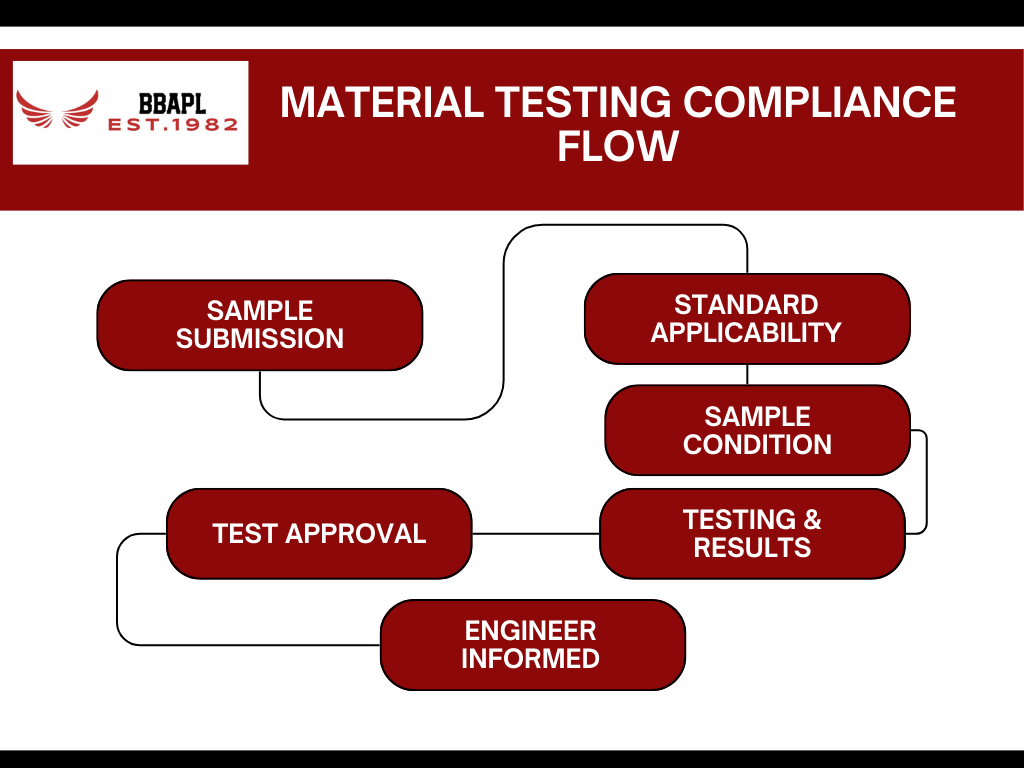
BBAPL’s “Lab-as-a-Service” model functions as an all-encompassing lifecycle management system for quality in construction materials:
Together, these functionalities grant engineers the knowledge to make confident and informed decisions for any large-scale project.
Looking for accurate and reliable material testing in Madhya Pradesh?
Get your samples tested with BBAPL’s NABL-accredited lab.
Understanding material testing is crucial for engineers in Madhya Pradesh to ensure structural safety, compliance, and durability. Following proper codes, using accredited labs, and leveraging modern digital solutions can significantly enhance project quality.
Key Takeaways
Ready to take your construction projects in Madhya Pradesh to the next level?
With BBAPL’s Lab Management Solution, following IS codes and NABL standards becomes simple, accurate, and strategic. Don’t just comply gain a competitive edge with real-time, traceable data that ensures safer designs, stronger structures, and sustainable development.
Contact BBAPL today to streamline your material testing and elevate project quality:
NABL requirements ensure that a testing laboratory follows ISO/IEC 17025 quality standards, uses calibrated equipment, maintains proper documentation, and delivers accurate, traceable results. An NABL-accredited lab like BBAPL meets all these criteria, ensuring reliable material testing reports accepted across government and private projects.
Key IS codes include IS 2720 for soil, IS 2386 for aggregates, IS 4031 and IS 516 for cement and concrete, IS 1786 for steel reinforcement, and IS 1203 series for bitumen.
NABL-accredited labs provide legally recognized test reports aligned with CPWD, PWD, and PMC norms, supporting audit readiness and project approvals within MP.
Soil, aggregates, cement & concrete, bitumen & asphalt, steel bars, bricks/blocks, construction-grade water, mix designs, and non-destructive testing (NDT) services.
It offers end-to-end lab management, including on-site sampling, digital logging, QR-coded reports, cloud archiving, and real-time data to ensure continuous quality and compliance throughout the project lifecycle.
Testing frequency depends on project stage, material consumption, and authority requirements. Regular interval testing helps detect variability before it impacts construction quality.
A failed result does not always mean rejection. Engineers may review redesign options, material replacement, or corrective measures based on project specifications and risk level.
While not always legally mandatory, most consultants, lenders, and third-party auditors now insist on NABL-accredited reports for acceptance and risk mitigation.
Authentic reports include unique sample identification, traceability details, and verifiable digital or QR-based validation issued by the testing laboratory.
No. Material properties vary by source, location, and batch. Each project and sampling location requires fresh testing to ensure accuracy and compliance.