India’s infrastructure, from rural roads and flyovers to government buildings, is driven by Public Works Department (PWD) projects. With ₹11 lakh crore allocated in 2026 (PIB), the focus on quality and compliance is at an all-time high, making NABL-certified material testing essential.
Material failure remains a major cause of structural defects, highlighting the need for standardized, reliable testing, not just better construction.
This guide outlines key PWD material testing requirements, including mandatory testing of soil, concrete, steel, aggregates, and bitumen as per IS codes, MORTH, and CPWD specifications. It also covers NABL accreditation, compliance processes, and risks of non-compliance, everything engineers and contractors need to ensure quality and audit readiness.
What Are PWD Projects & Why Material Quality Is Non-Negotiable
PWD projects are government-funded civil infrastructure works executed under central or state Public Works Departments. They include:
- Roads, highways, and rural connectivity projects
- Bridges, culverts, and flyovers
- Government buildings, hospitals, and schools
- Drainage, water supply, and irrigation infrastructure
Material quality in these projects isn’t a preference, it’s a legal and structural obligation. Poor-quality materials don’t just cause structural failure; they trigger audit objections, contractor blacklisting, and in severe cases, criminal liability under the Prevention of Corruption Act.
“A structure is only as strong as the material it’s built with, and only as trustworthy as the test that certified it.”
Why PWD Projects Require NABL Labs
PWD projects require NABL-accredited labs to ensure all material tests meet standardized, verified, and legally accepted quality benchmarks.
This ensures test results are reliable, audit-compliant, and accepted by authorities for approvals and payments.
- Accepted in CAG and departmental audits
- Ensures tamper-proof, standardised testing
- Recognised under international agreements (ILAC/APAC)
- Mandatory in most PWD and government tenders
Skipping material testing in PWD projects can lead to serious consequences:
- Project delays: Failed inspections or rework halt progress and disrupt timelines.
- Payment rejection: Bills may be withheld or rejected due to missing test reports and non-compliance.
- Audit penalties: Non-compliance with IS/MORTH/CPWD norms can attract fines and strict audit objections.
- Structural failure: Undetected material weaknesses can cause cracks, settlement, or even collapse, risking safety and costly repairs.
India has 7,000+ accredited labs, but only a limited number specialise in construction materials, choosing the right lab is critical.
How to Select the Right NABL Lab for Your PWD Project
Not all NABL Accredited Laboratories in India test all materials. Before empanelling a lab, verify:
- Scope of accreditation: Does it cover the specific tests your project needs?
- Geographic proximity: Turnaround time affects construction schedules
- State PWD recognition: Some states maintain approved lab lists
- Equipment calibration status: Check the last calibration date for critical instruments
- Reporting turnaround: Standard labs offer 3–7 days; urgent projects need faster SLAs
Governing Standards: IS Codes, MORTH & CPWD Specifications
Every PWD project is bound by a specific set of technical standards depending on its type. Here’s a quick reference:
| Project Type |
Governing Standard |
Key Focus Areas |
| Roads & Highways |
MORTH Specifications (5th Revision) |
Bitumen, aggregates, sub-base, compaction |
| Structural Buildings |
CPWD General Specifications |
Cement, steel, concrete, masonry |
| Concrete Works |
IS 456:2000 |
Mix design, water-cement ratio, cube strength |
| Steel & Reinforcement |
IS 1786:2008 |
Tensile strength, bend test, elongation |
| Aggregates |
IS 2386 (Parts I–VIII) |
Gradation, impact value, crushing strength |
| Soil & Foundation |
IS 2720 (Series) |
CBR, compaction, bearing capacity |
| Cement |
IS 269, IS 1489 |
Fineness, setting time, compressive strength |
Types of Materials Tested in PWD Projects
- Cement & Concrete: OPC 43/53, PPC, tested for compressive strength (IS 516), consistency, and setting time. Concrete cubes are tested at 7-day and 28-day intervals.
- Steel & Reinforcement: TMT bars tested per IS 1786, tensile strength, yield strength, elongation, and bend/rebend tests.
- Soil & Geotechnical: CBR (IS 2720 Part 16), Proctor compaction, liquid limit, and bearing capacity tests before foundation and road sub-base work.
- Aggregates: Crushing value, impact value, abrasion, and gradation as per IS 2386. Critical for both concrete and road base courses.
- Bitumen & Road Materials: Penetration, softening point, ductility, and viscosity tests per IS 73 and MORTH specifications.
- Water for Construction: Often overlooked, water used in concrete mixing must be tested for pH, chloride content, and organic matter per IS 456 Clause 5.4.
- Bricks & Masonry Units: Water absorption, compressive strength, and efflorescence testing as per IS 3495.
Mandatory Testing Checklist with IS Code References
| Material |
Mandatory Test |
IS Code |
Minimum Frequency |
| Cement |
Compressive strength, setting time |
IS 269 / IS 4031 |
Every consignment |
| Concrete |
Cube crushing strength (7 & 28 day) |
IS 516 |
Every 50 cum or as per QAP |
| TMT Steel |
Tensile, bend, elongation |
IS 1786 |
Every lot / heat number |
| Coarse Aggregate |
Impact, crushing, gradation |
IS 2386 |
Every 100 MT |
| Fine Aggregate |
Sieve analysis, silt content |
IS 2386 Part I |
Every 50 MT |
| Soil (Sub-grade) |
CBR, OMC, MDD |
IS 2720 |
Every 500 m road stretch |
| Bitumen |
Penetration, softening point |
IS 73 |
Every tanker |
| Bricks |
Compressive strength, absorption |
IS 3495 |
Every 10,000 units |
Stage-wise Testing Requirements
Stage-wise testing requirements play a critical role in ensuring quality, safety, and compliance throughout a construction project. From pre-construction investigations to post-construction validation, systematic testing at every stage helps identify issues early, maintain standards, and ensure long-term structural performance.
Pre-Construction
- Soil investigation report and bore log submission
- Material source approval from PWD engineer
- Lab empanelment confirmation (NABL status verification)
During Construction
- Batch-wise sampling as per QAP (Quality Assurance Plan)
- On-site cube casting and slump tests
- Compaction tests at every layer of road construction
Post-Construction
- Core cutting test for roads (density and thickness)
- Load testing for RCC structures where specified
- Final material test certificate compilation for handing over
Material Testing Process: From Sampling to Report Submission
A reliable testing process follows these steps:
- Sample collection: Done by an authorised engineer; witnessed sampling is required for third-party tests
- Sample sealing and dispatch: Chain of custody must be maintained; tampered samples are rejected
- Lab testing: Conducted under ISO/IEC 17025 protocols in NABL-accredited facilities
- Report generation: Issued with NABL stamp, lab registration number, and test date
- Submission to PWD: Attached with Running Account (RA) bills and compliance statements
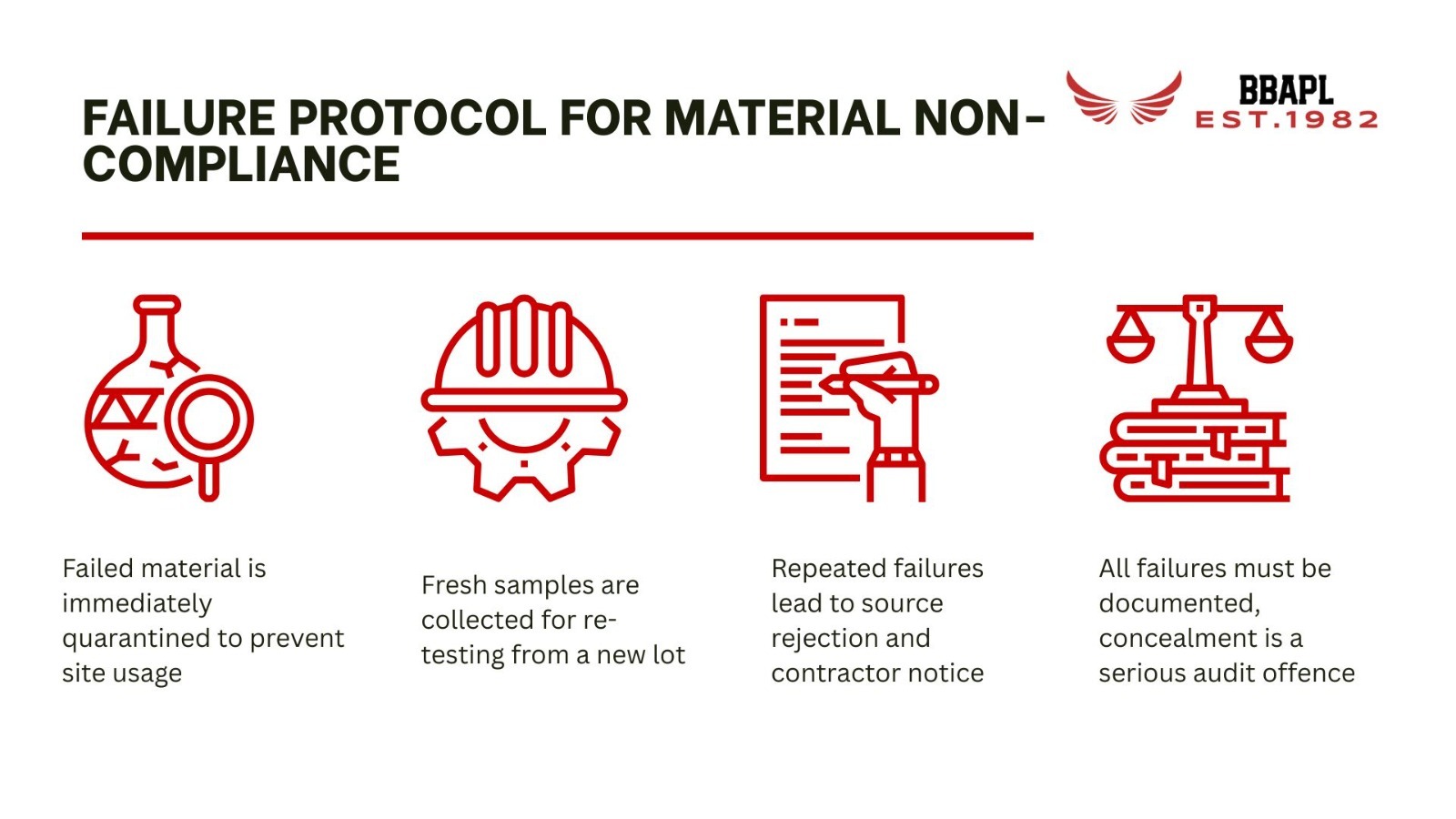
Failure Protocol: If a material fails, the following steps apply:
- The failed lot is quarantined immediately
- Re-sampling and re-testing from a fresh lot is conducted
- Persistent failure leads to source rejection and contractor notice
- All failure records must be documented, hiding failures is an audit offence
Cost of Material Testing: What to Budget For
Testing costs vary by material, location, and lab. Indicative ranges:
- Concrete cube test (set of 3): ₹600 – ₹1,200
- Soil CBR test: ₹2,500 – ₹5,000
- TMT steel lot testing: ₹1,500 – ₹3,500
- Bitumen full suite: ₹4,000 – ₹8,000
- Comprehensive geotechnical investigation: ₹25,000 – ₹1,50,000 depending on bore depth and scope
Budgeting 0.5%–1% of total project cost for testing and quality assurance is standard practice in well-managed PWD contracts. Skipping this almost always costs more in rework.
Common Challenges & How to Overcome Them
Delays, errors, and compliance gaps in material testing can quickly derail project timelines and audit outcomes if not addressed early. Proactive planning, trained teams, and strict documentation practices are key to overcoming these challenges effectively.
- Delayed lab reports: Pre-empanel labs before mobilisation; agree SLAs in writing
- Use of non-accredited labs: Verify NABL status on nabl.india.org/ before every engagement
- Improper sampling: Train site engineers on IS 2430 sampling procedures
- Budget pressure to skip tests: Document all test waivers formally; verbal approvals are not defensible
- Inconsistent documentation: Use a standardized test register template from day one
Zero Audit Error PWD Testing: BBAPL Case Snapshot
Bhargava Building Atelier Pvt Ltd., has consistently delivered compliant, audit-ready material testing across active government infrastructure projects. With strict adherence to IS codes and NABL standards, every test is executed with precision and accountability.
- Delivered testing for projects like DRDO (Gwalior) and Sank River Anicut (Morena)
- Conducted all tests strictly as per IS codes and NABL protocols
- Maintained proper sampling, chain of custody, and QAP-based frequency
- Generated accurate, fully documented, audit-ready reports
- Ensured timely delivery without compromising quality
Result: Faster approvals, zero audit issues, and reliable project execution
Consequences of Skipping NABL-Certified Testing
This is where compliance failures become costly:
- Tender disqualification: RA bills rejected if non-NABL certificates are submitted
- CAG audit objections: Recovery of payment amounts is common in audit findings
- Structural liability: Engineer-of-record faces professional and legal accountability
- Blacklisting: Contractors can be debarred from future PWD tenders
- Criminal exposure: Under Section 304A IPC, negligence causing structural harm is prosecutable
India loses an estimated ₹3,000 crore annually to rework and rectification in public infrastructure,much of it traceable to inadequate material testing at source.
Documentation & Compliance Requirements
Accurate documentation is critical for smooth audits and uninterrupted project approvals in PWD works. Well-maintained records ensure transparency, traceability, and faster compliance verification at every stage.
- NABL-certified test reports (material-wise, date-wise)
- Quality Assurance Plan (QAP) approved by PWD
- Site inspection register with engineer signatures
- Material approval memos from PWD
- Third-party inspection reports (where applicable)
- Failure records and corrective action notes
Future Trends in Government Project Testing
- Digital test reporting: BIS and NABL are moving toward portal-integrated digital certificates, reducing fraud
- AI-based defect detection: Image recognition tools are being piloted for crack detection and aggregate gradation analysis
- Green material testing protocols: As fly ash, GGBS, and recycled aggregates enter PWD specs, new IS codes are being drafted
- Real-time monitoring: IoT-enabled compaction and concrete sensors are being trialled under PMGSY smart quality monitoring pilots
Also Check: Future of Material Testing Industry in India: Role of Accredited Testing Laboratories
Best Practices for PWD Compliance in 2026
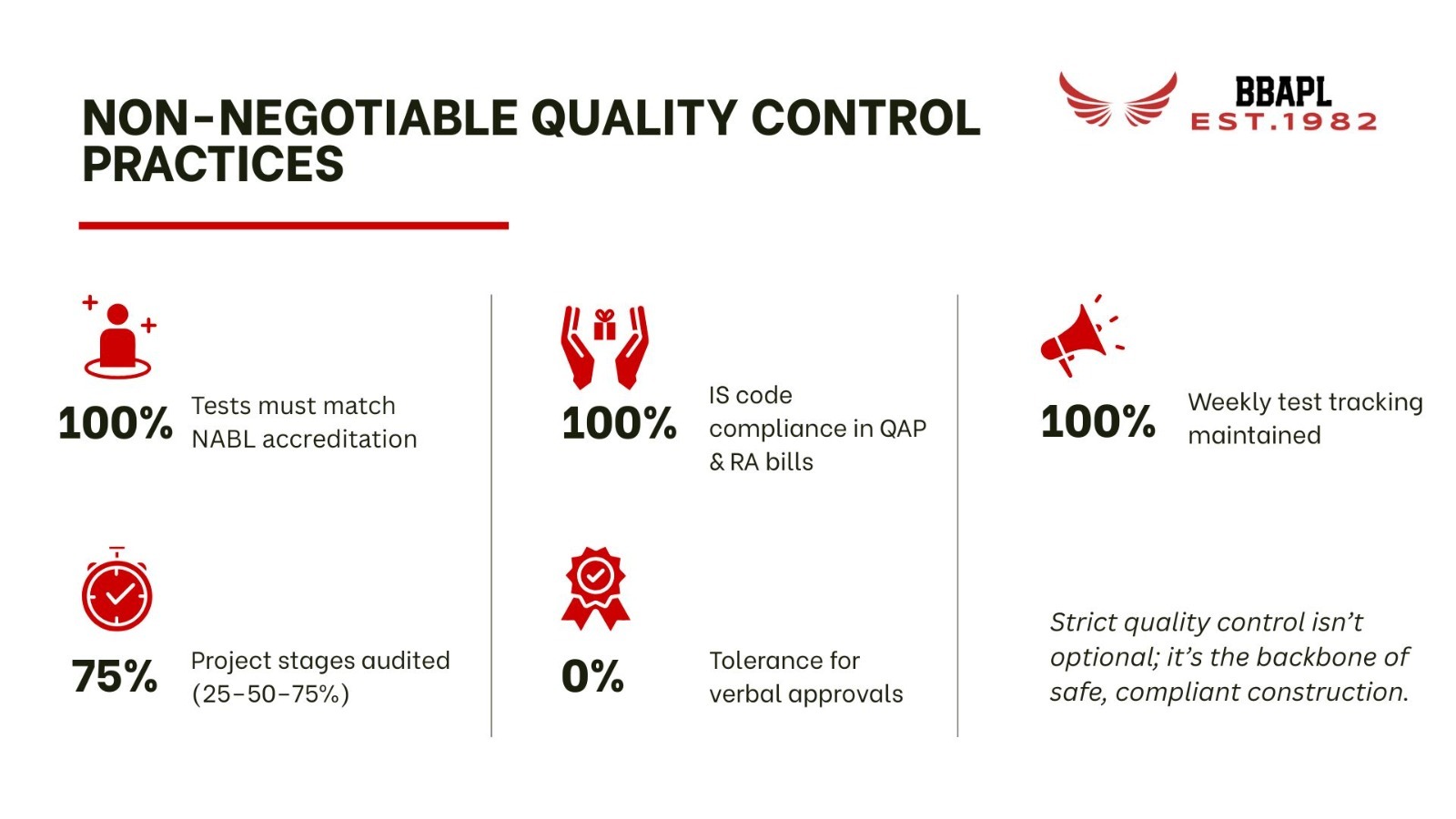
Always cross-check the lab’s accreditation scope before commissioning any specific tests to ensure compliance and accuracy. Clearly reference relevant IS codes in your QAP and RA bill submissions to avoid disputes and maintain standardization.
Keep a test frequency register updated weekly across active sites for better tracking and accountability. It’s also important to conduct internal audits at key milestones, 25%, 50%, and 75% of project completion, to catch issues early.
Lastly, never rely on verbal clearances; every material approval should be properly documented in writing.
Conclusion
In 2026, material testing in PWD projects is no longer a back-end formality, it is embedded into tenders, audits, and contractor evaluations. Those who integrate NABL-certified testing into their workflow deliver durable, audit-ready infrastructure. Quality doesn’t add cost; poor quality does.
As projects become more accountable and performance-driven, testing will define long-term credibility.
Need NABL-certified material testing for your PWD project? Ensure zero audit issues and full compliance with IS codes
Get in touch: +91-9630150426 | info@bbapl.in
People Also Ask
-
Is NABL accreditation mandatory for all PWD projects?
Most state PWDs and central schemes (PMGSY, Smart Cities) now mandate it. Always check the specific tender conditions.
-
Can a contractor arrange testing from their own lab?
Only if that lab is NABL-accredited and independent of the contractor’s direct control. Most PWDs prefer third-party labs.
-
What if a test fails after construction is complete?
The engineer-of-record and contractor are jointly liable. Remediation or demolition may be ordered depending on severity.
-
How often should NABL accreditation be verified?
Before every project engagement, accreditation has renewal cycles and scope can change.
-
Can test reports be digitally submitted for PWD approvals?
Yes, many departments now accept digital submissions, but they must be verifiable and traceable to the issuing NABL lab.
-
Who is responsible if incorrect sampling leads to wrong test results?
The site engineer or authorised sampling personnel is accountable, as improper sampling invalidates the entire test process.
-
Are surprise audits conducted on material testing records?
Yes, PWD and audit bodies may conduct unannounced checks on site records, lab reports, and material sources.
-
Can testing frequency be reduced under tight project timelines?
Only with formal written approval from the competent authority; otherwise, it is treated as a compliance violation
-
What role do consultants play in material testing compliance?
Project consultants or PMC teams often verify test reports, witness sampling, and ensure adherence to QAP requirements.
-
How are disputes over test results typically resolved?
Disputes are usually addressed through third-party re-testing at an independent NABL-accredited lab agreed upon by both parties.