A Structural Stability Certificate (SSC) is a technical validation of a building’s safety, load-bearing capacity, and compliance with engineering standards. It is a pressing need in Madhya Pradesh to approve operations and property transactions.
Generally, an SSC has a validity of 3 to 5 years, and it costs between INR 10,000 and INR 50,000 and above according to the size, complexity, and testing necessities of the building.
The certification must be considered an organized engineering practice that entails documentation, inspection, testing, and compliance checks, typically carried out under Structural Engineering Consultancy in India frameworks rather than being treated as a formality.
This guide contains the full checklist, steps process, and technical specifications regarding the expert view.
Proper documentation is of much importance in preventing delays in the approval of certifications. Structurally sound buildings may be rejected too because of missing or inconsistency in records.
Expert Insight: Documentation is not merely a procedure, it enables the engineers to confirm the design intention and actual performance that is vital for the correct assessment.
These regulations, enforced by the Directorate of Town and Country Planning, govern construction, safety, and design standards to ensure buildings are structurally sound, compliant, and sustainable.
These bye-laws define critical requirements such as land use approvals, setbacks, height regulations, and safety provisions that guide compliant construction and certification.
They ensure every structure meets planning, environmental, and structural standards before approval, reducing risks and ensuring long-term stability.
Structural Stability Certification is also supported by statutory frameworks that regulate construction and urban development in Madhya Pradesh:
Structural Stability Certification (SSC) in Madhya Pradesh follows a structured, multi-stage engineering procedure. These are aligned with local authority expectations, national standards, and safety regulations. Whether it is for the industrial, commercial, or residential buildings, each step ensures compliance with MP-specific.
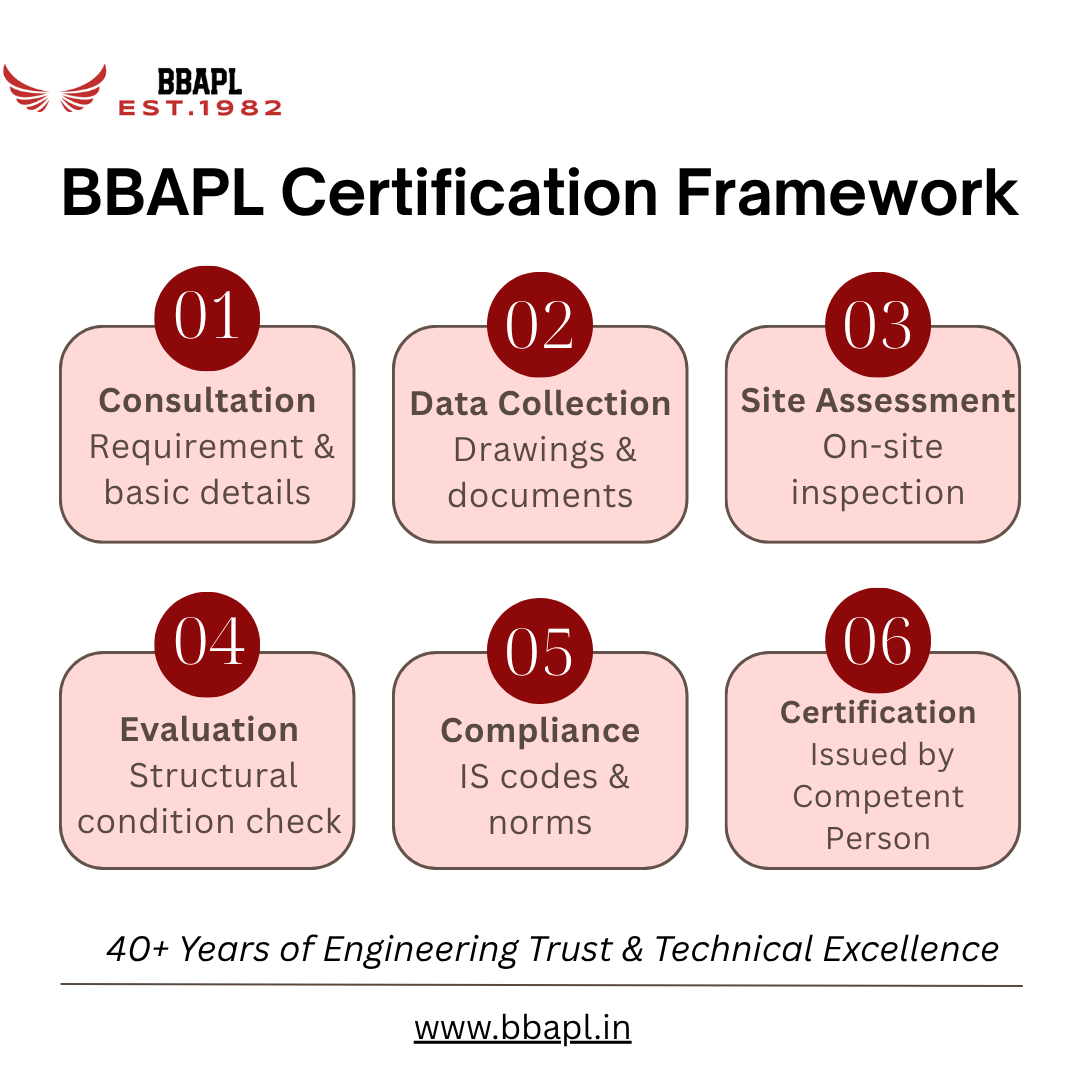
BBAPL follows a step-by-step certification process for reliable results. Ensuring your building meets all safety and compliance standards.
Structural inspections are done to determine the actual condition and performance of the building. Moreover, the engineers evaluate the following:
In high-density and developing urban regions such as Indore, Bhopal, and Gwalior, inspections often include verification of modifications and usage changes.
The need to test arises when the structural safety cannot be assured based on the drawings, records, and visual examination. The judgment of engineering in such situations has to be backed by data that can be measured.
The following tests are typically conducted to assess material strength and structural integrity:
All tests must be carried out by qualified and recognised bodies to ensure credibility and compliance. These include:
When there is uncertainty regarding foundation performance, the geotechnical investigation and soil testing reports are required. These help validate the stability and load-bearing capacity of the supporting ground system.
To obtain Structural Stability Certification in Madhya Pradesh, the structure must meet the following:
The validity of structural stability certificates in Madhya Pradesh depends on the building type and regulatory requirements.
Delays in Structural Stability Certification are often caused by avoidable errors rather than technical complexities. Identifying these common mistakes early helps ensure a smoother and faster approval process.
Structural Stability Certification is not a regulatory formality, but rather a process-based engineering assessment. It combines documentation, inspection, testing, and law and standard compliance to make sure that real-life safety is achieved.
A checklist-based approach structure reduces the time, enhances accuracy, and makes sure that the building is safe, compliant, and operationally dependable.
Bhargava Building Atelier Pvt. Ltd. (BBAPL) offers the complete service of inspection, testing, and certification with the involvement of professional assistance. Per the requirements of the regulations and the best practices of the engineering industry.
📞 +91-9630150426
📧 info@bbapl.in
Yes, engineers can assess such structures through detailed site inspections and testing, even if original drawings are unavailable.
Yes, any increase in load—especially in industrial setups—should be evaluated to ensure the structure can safely handle it.
In some cases, authorities or buyers may demand it to confirm the building’s safety before finalizing transactions.
Yes, prolonged leakage can weaken structural elements over time and may raise concerns during inspection.
They require specialized assessment methods and careful evaluation due to age, materials, and construction techniques.
Yes, a post-event structural audit is highly recommended to ensure the building is still safe for use.
Yes, especially in commercial or industrial spaces where safety compliance is critical for operations.
Minor cosmetic work does not, but structural renovations like wall removal or extensions do require reassessment.
Many authorities now accept digitally signed reports, but requirements may vary depending on the local body.

Talk to Our Experts Today — We're just a call or message away.

Already a member? Sign in now