Every Collapse Had a Warning. Most Were Ignored. In the past few years, building collapses across India have revealed a pattern that is difficult to ignore. These failures may appear sudden, but investigations consistently trace them back to familiar causes, weak foundations, material deterioration, and structural changes made without proper engineering oversight.
The scale of the issue is significant. With over 2,500 deaths recorded due to building collapses in recent years, the risk is no longer occasional, it is systemic (The Hindu) This is further compounded by the fact that a large portion of India’s existing buildings still do not fully comply with current safety codes defined by the Bureau of Indian Standards.
These are not isolated incidents. They reflect a construction approach where structural risks are often addressed too late. In many cases, Structural Engineering Consultancy India services are brought in after key decisions are made, when they should be shaping them from the very beginning.
The most critical structural decisions are made where they are least visible, below ground.
In rapidly developing regions, soil testing is often treated as a formality rather than a design driver. Basic tests may confirm surface bearing capacity, but fail to capture deeper soil behavior or long-term environmental effects.
What begins as a small imbalance evolves into differential settlement, placing uneven stress on the entire structure.
The focus has shifted from initial strength to long-term behavior under real conditions, an essential shift driven by modern Structural Engineering Consultancy India practices.
Corrosion is one of the most underestimated structural risks because it develops inside the concrete long before visible damage appears.
“Chloride-induced corrosion contributes to nearly 40% of premature structural deterioration in coastal Indian buildings under 30 years of age.”
Hindustan Times
Moisture and chlorides enter concrete through cracks, porous surfaces, or inadequate cover. Requirements related to concrete cover, durability exposure conditions, and reinforcement protection are defined under IS 456, making it a key reference during structural inspection and corrosion assessment.
The visible damage usually appears at a much later stage, which is why Structural Failure Analysis India plays a critical role in early detection and preventive assessment.
Rebar corrosion is mainly caused by moisture ingress, poor concrete quality, inadequate cover over reinforcement, and long-term exposure to chlorides in coastal or high-humidity environments.
Modern structural inspections now use methods such as ground-penetrating radar (GPR), half-cell potential testing, and carbonation depth analysis to identify corrosion before severe damage develops.
Common signs include rust stains, cracks along reinforcement lines, concrete spalling, and exposed steel bars. These symptoms indicate that corrosion has already started affecting the structural integrity of the building.
The most common structural failures in India include foundation settlement, rebar corrosion, poor concrete quality, unauthorized structural alterations, and inadequate seismic detailing.
Few risks are as common, and as preventable, as unauthorized structural changes.
Buildings are often modified after completion to meet new requirements, but without understanding how those changes affect structural behavior.
These changes force the structure to operate under conditions it was never designed for. The result is not immediate collapse, but gradual overstressing leading to eventual failure.
The principle remains unchanged: A structure cannot safely carry loads it was never engineered to support.
Earthquakes don’t just test strength, they test how a structure responds to movement.
Many buildings in India are still designed primarily for vertical loads, with limited attention to lateral forces.
Resilient structures are not rigid, they are designed to adapt under stress.
A clear view of how structural failures originate, and how modern engineering prevents them. From root causes to real solutions, this is where analysis meets action.
| Failure Type | Root Cause | Earlier Practice | Modern Prevention |
|---|---|---|---|
| Foundation Failure | Poor soil investigation | Minimal testing, shallow assumptions | Geotechnical mapping + advanced analysis |
| Rebar Corrosion | Low durability materials | Visual inspection only | GPR, durability testing, protective systems |
| Unauthorized Changes | Lack of structural validation | No pre-alteration review | Impact assessment + structural audits |
| Poor Concrete Quality | Uncontrolled mix practices | On-site trial batching | Certified materials + standardized testing |
| Seismic Vulnerability | Non-ductile structural design | Gravity-focused design | Code-compliant ductile detailing |
At JK Tyre’s Banmore Unit, a 2,500 sq.m coal and biomass storage PEB shed required a detailed structural evaluation to ensure it could safely support operational loads and maintain long-term performance under varying conditions.
BBAPL conducted a comprehensive structural assessment, focusing on the shed’s framework, connections, and overall stability. Detailed analysis was carried out to evaluate load-bearing capacity specific to storage requirements, while ensuring full compliance with relevant engineering standards.
The assessment validated structural integrity, strengthened safety compliance, and ensured the shed could reliably support operational demands without risk.
It demonstrates how proactive structural inspection and Structural Failure Analysis India practices help prevent risks before they escalate, ensuring safety, compliance, and uninterrupted operations in industrial environments.
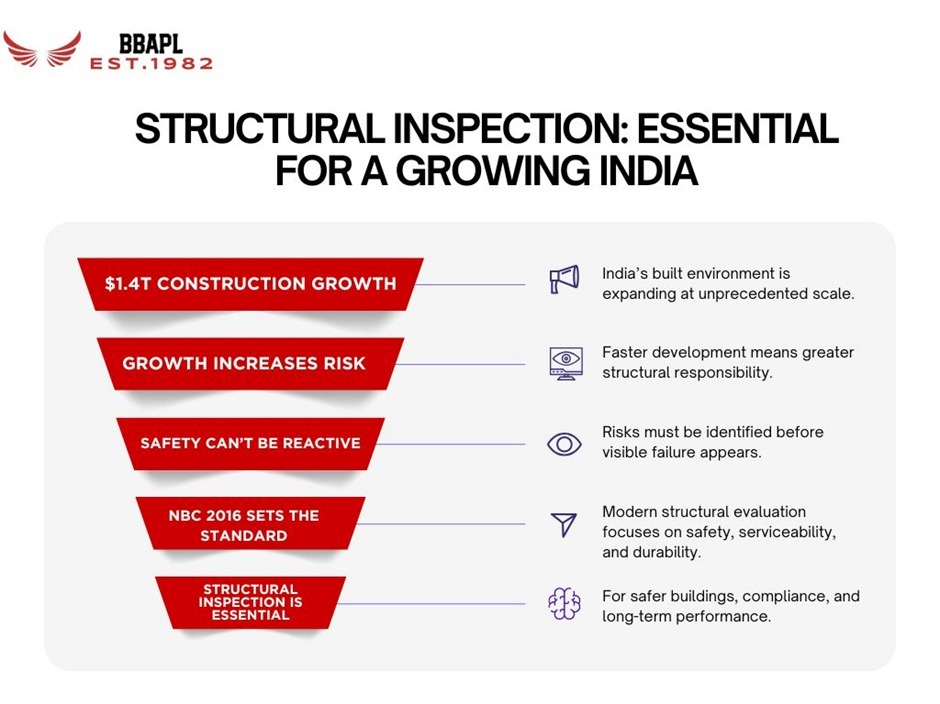
India’s construction sector is projected to reach $1.4 trillion, making it one of the fastest-growing globally (Economic Times). That growth brings a choice, to scale existing risks, or strengthen systems through better engineering practices.
Current structural evaluation practices are increasingly aligned with
National Building Code (NBC) 2016, which places stronger emphasis on structural safety, serviceability, fire safety integration, and lifecycle performance.
Own or manage a building over 15 years old? Planning modifications or vertical expansion? Noticing visible cracks, settlement, or signs of distress? These are all strong indicators that a structural inspection should not be delayed.
Early assessment helps identify hidden risks before they become major structural failures, reducing repair costs, improving safety, and ensuring compliance with current standards.
For developers, institutions, and property owners alike, structural inspection is no longer just a corrective measure. It is a proactive step toward safer buildings, stronger performance, and long-term reliability.
For project consultations or structural inspections, you can reach out at
+91-9630150426
or email info@bbapl.in.
Because if a structure hasn’t been evaluated, it isn’t safe; it is simply unverified.
A Structural Engineering Consultancy in India provides services such as design validation, load analysis, safety audits, and ensuring compliance with national building codes.
Structural Failure Analysis in India should be conducted when there are signs of distress, unexpected damage, or performance issues in a building or structure.
Structural Inspection in India is generally recommended every 5–10 years, or sooner for older buildings and high-load structures.
Early involvement ensures better design decisions, reduces risk, improves material efficiency, and prevents costly structural corrections later.
By identifying hidden weaknesses early, Structural Failure Analysis in India helps prevent major repairs and extends the lifespan of structures.
Structural Inspection in India ensures that industrial facilities meet safety standards and can handle operational loads without risk of failure.
Building Safety MP is gaining focus due to increasing regulatory awareness and the need to ensure structural compliance in rapidly developing regions.
Yes, it helps assess existing structural capacity and ensures that any modifications or upgrades are safe and compliant.
Modern Structural Failure Analysis in India uses tools like structural modeling software, non-destructive testing, and advanced material analysis techniques.
While not always mandatory nationwide, many regions and authorities strongly recommend Structural Inspection in India for commercial and public-use buildings.

Talk to Our Experts Today — We're just a call or message away.

Already a member? Sign in now