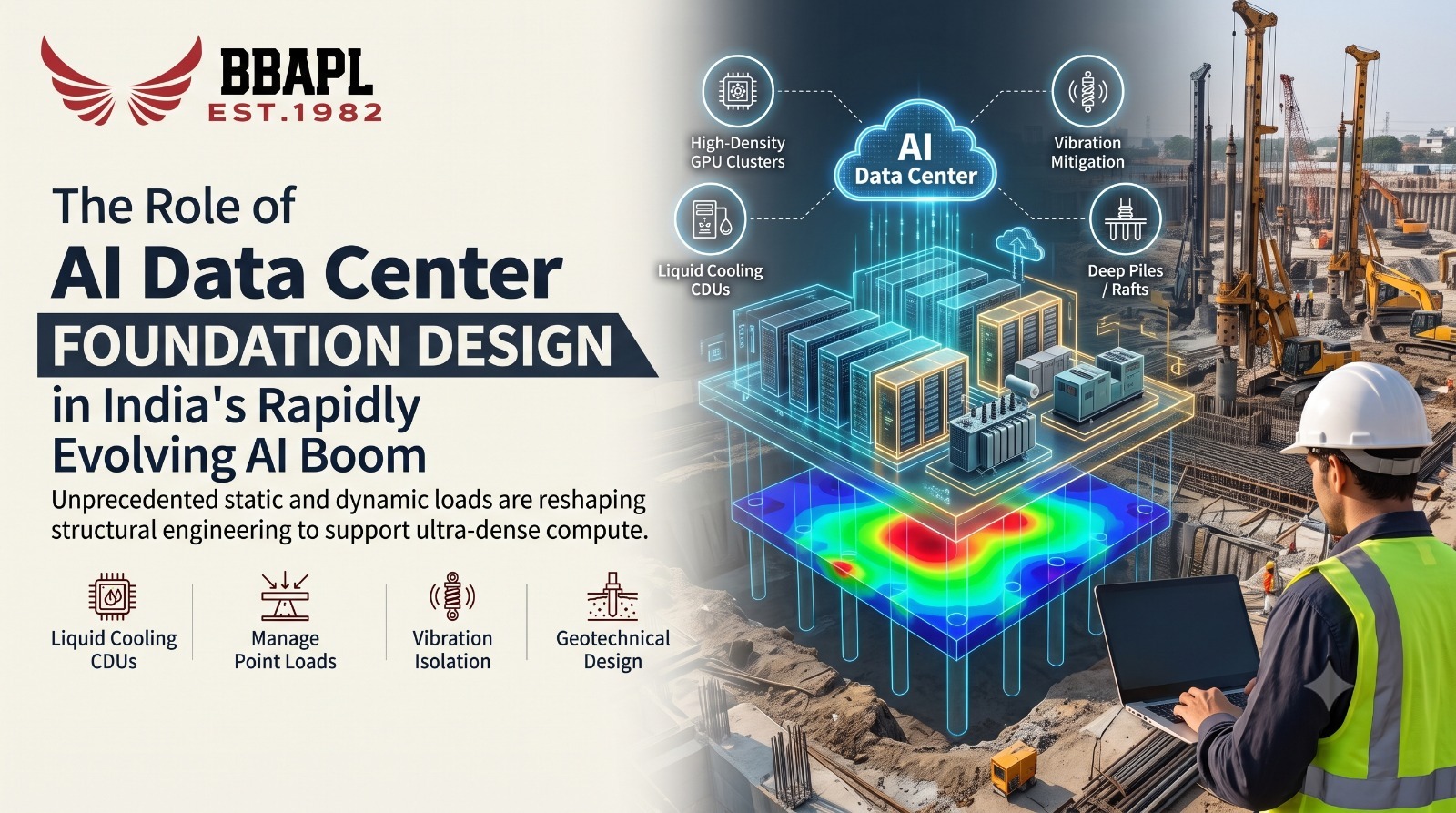
AI data center foundation design in India is becoming increasingly important as Artificial Intelligence in India is rapidly growing and changing the way India is technologically evolving and is also changing the principles of Structural Engineering. As hyperscalers begin to move into their mission-critical facilities, traditional server architectures are giving way to ultra-dense clusters of compute, which are subject to unprecedented static and dynamic loading on floor slabs, substructures, and subsoils.
India’s operational data center capacity grew to around 1.8 GW in 2026, while power density per rack in data centers in India increased from 10 kW to more than 100 kW, according to the latest industry data. This growth imposes a heavy burden and demands a critical solution for all the active data centers under construction in India. This blog focuses on the transformative impact of high-density AI infrastructure on geotechnical assessment, load-bearing slab design, and structural quality assurance in India.
To meet the needs of high-density AI server clusters, the traditional structural floor slab and substructure load transfer model must be completely changed.
Sensitive micro-electronics require special structural isolation from continuous dynamic vibration from heavy support machinery.
The geotechnical foundation designs need to be specific to the soil profile, seismic zones, and coastal soil conditions of the major data hubs in India.
Tight delivery deadlines require the ability to use modular foundation construction, as well as a high degree of material verification with NABL accreditation.
BBAPL has been in this engineering consultancy field for the last 45+ years, continuously evolving alongside industry trends and advancements in structural design. The firm delivers structural engineering, geotechnical consultation, and quality assurance solutions across diverse infrastructure domains.
BBAPL has successfully delivered structural design and engineering consultancy services for multiple institutional and educational infrastructure projects, ensuring safety, efficiency, and future-ready environments.
From initial concept to final compliance, BBAPL ensures every project supports safe, efficient, and inspiring learning and healthcare environments with uncompromising engineering standards.
The expansion of artificial intelligence in India is redefining structural and geotechnical engineering requirements for modern data centers. Supporting high-density AI server racks, heavy liquid cooling infrastructure, and continuous dynamic equipment loads requires moving far beyond conventional slab designs.
Successfully delivering these mission-critical facilities depends on thorough geotechnical investigations, specialized vibration-isolated equipment foundations, region-specific substructure engineering, and rigorous material quality verification. As facility capacities scale and construction timelines compress, precision engineering at the foundation layer remains essential for long-term operational resilience and structural stability.
For specialized technical consultation, geotechnical soil testing, NABL-accredited material testing, or structural design services for mission-critical infrastructure projects, connect with the BBAPL engineering team:
Call Us: +91 96301 50426
Email Us: info@bbapl.in
Official Website: www.bbapl.in
AI racks draw 40kW to 100+kW and weigh 1,500kg to 3,000+kg per unit, creating severe, concentrated point loads. Liquid cooling infrastructure adds further static weight, requiring post-tensioned slabs and heavy mat foundations instead of standard elevated slabs.
Engineers conduct Dynamic Soil-Structure Interaction (SSI) modeling and isolate heavy equipment (gensets, chillers, and pumps) on concrete inertia blocks fitted with spring isolators to absorb continuous low- and high-frequency vibrations.
Coastal hubs with soft marine clay and high salinity (like Mumbai and Chennai) require deep bored cast-in-situ piles, friction piles, or combined raft-pile foundations paired with anti-corrosive concrete mixes to distribute heavy loads and prevent settlement.
In high seismic zones (like NCR Zone IV), foundations use heavily reinforced mat slabs and seismic isolation bearing pads capable of handling simultaneous vertical compute loads and horizontal lateral earthquake forces.
Deep borehole logging, cross-hole seismic testing, and shear wave velocity (Vs30) evaluations determine safe soil bearing capacity and dynamic properties, ensuring foundations are engineered to prevent differential settlement.
Factory-cured precast concrete footings, pre-engineered modular trenches, and early-strength concrete mixes allow off-site fabrication and faster curing, reducing site pour schedules by up to 30%.
Substructure quality verification requires NABL-accredited testing of cement and rebar, followed by Non-Destructive Testing (NDT), such as Pile Integrity Testing (PIT), Rebound Hammer, and Ultrasonic Pulse Velocity tests, during site execution.
Bhargava Building Atelier Pvt Ltd (BBAPL) leverages over 45 years of engineering experience, performing 3D structural modeling (ETABS/STAAD Pro) and dynamic load analysis compliant with Indian Standard codes (IS 456, IS 1893, IS 2911) and the National Building Code (NBC).
Through its in-house, NABL-accredited testing laboratories, BBAPL provides subsoil investigations, plate load tests, concrete mix design validation, steel rebar testing, and non-destructive core integrity assessments for site quality assurance.
Yes, BBAPL conducts certified structural safety audits, non-destructive testing, and retrofitting design (such as RCC jacketing and carbon-fiber wrapping) to upgrade load capacities for expanding or repurposed facilities.
Talk to Our Experts Today — We're just a call or message away.

Already a member? Sign in now