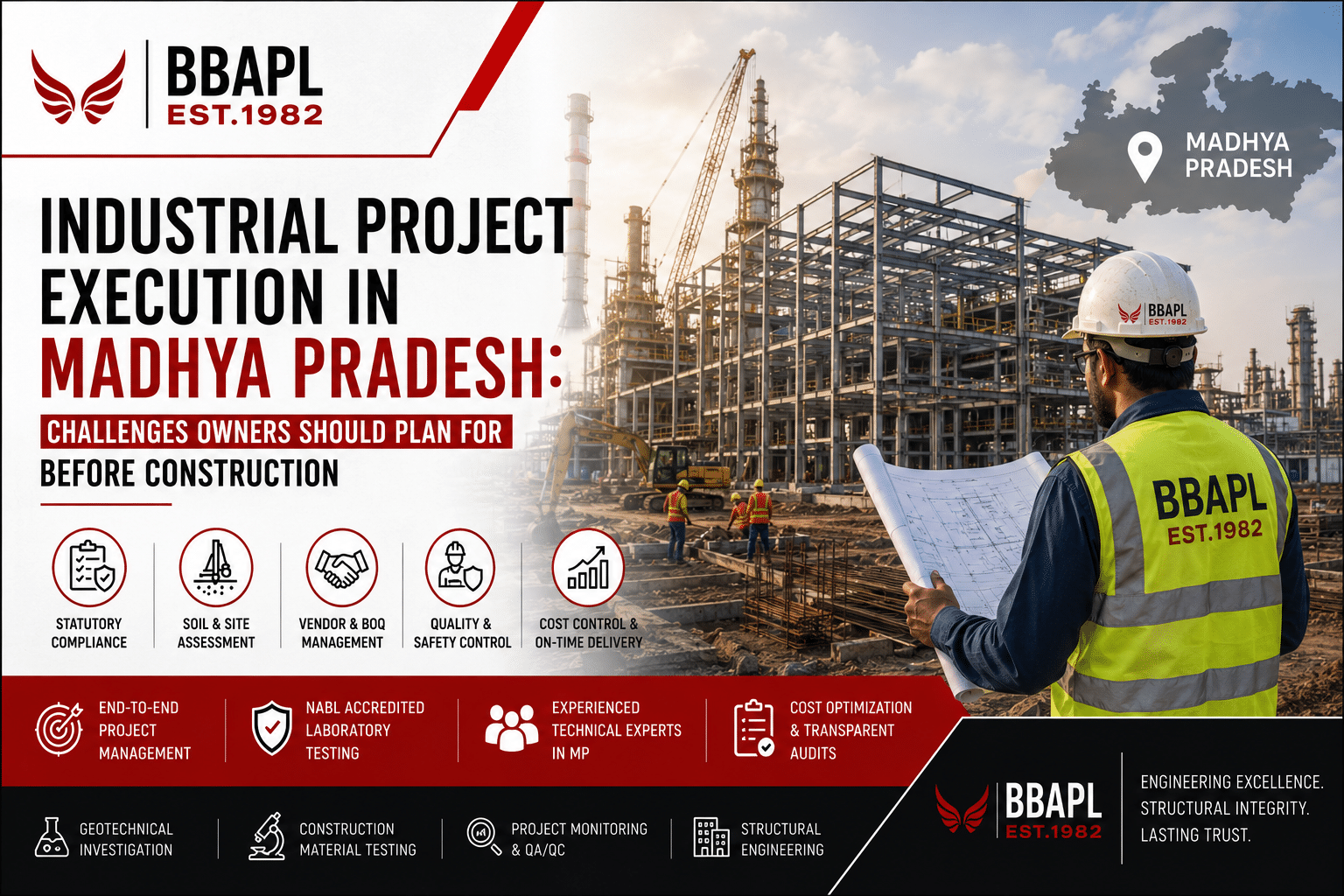
Madhya Pradesh has developed several important industrial clusters, including Pithampur, Mandideep and Malanpur, supporting manufacturing, logistics, pharmaceuticals, automotive and other industrial activities. As new facilities and expansions move from planning to execution, project owners must account for site conditions, statutory approvals, utilities, procurement, quality control and contractor coordination from the beginning.
However, industrial projects in Madhya Pradesh must account for region-specific site conditions, climate, infrastructure, approvals and contractor coordination challenges.
In this blog, we will be talking about the most prominent pre-construction execution challenges in Madhya Pradesh and how you can mitigate the risk of losing your capital investment by leveraging specialized Industrial Project Execution Services in Madhya Pradesh.
The central location of Madhya Pradesh, its multimodal transport options, and the government policy, which is pro-business, make it a greenfield and brownfield expansion hub. But large-scale engineering works in the state will have to deal with varying conditions and operations in each region.
The planning of project execution for industrial projects in MP is not only about implementing a standard civil design, but it also involves anticipating and adjusting to these environmental and logistical challenges.
Securing statutory clearances in Madhya Pradesh involves navigating multiple regulatory bodies, local planning authorities, and state-level compliance frameworks. Misalignment at this stage can delay groundbreaking by months.
| Regulatory Area | Core Clearance / Compliance Requirement | Potential Issue & Bottleneck | Mitigation Strategy |
|---|---|---|---|
| Environmental | Applicable environmental approvals and MPPCB consents | Approval sequencing and documentation gaps | Integrate environmental engineering norms directly into early schematic plant drawings. |
| Land & Planning | Land-use permissions, layout approvals and applicable development permissions | Land-use or layout inconsistencies | Engage local execution consultants for rapid boundary verification and layout alignment. |
| Fire & Life Safety | Applicable fire safety approvals/NOC requirements | Late changes to fire-safety provisions | Perform pre-construction safety audits and regulatory design reviews. |
| Building & Structural Compliance | Applicable building regulations, NBC provisions and structural design requirements | Design revisions during execution | Conduct pre-construction structural safety audits and multi-disciplinary design coordination reviews. |
| Utilities | Power, water, drainage and other utility permissions | Delayed connections or inadequate capacity planning | Submit early utility demand estimations and design dedicated substation/infrastructure layout plans. |
Madhya Pradesh is facing one of the greatest engineering hazards in the country: the black cotton soil, which is found in the Malwa and central parts of the State. The type of soil expands when wet and contracts greatly when dry, and puts enormous strain on foundations.
Comprehensive construction management in Madhya Pradesh involves initial testing of the soil, as well as validation of materials by testing through a NABL-accredited laboratory within the applicable scope of accreditation, ensuring the safety of the structures and construction budgets.
Multiple special industrial contractors, from Civil Works and Pre-Engineered Building (PEB) fabricators to Mechanical, Electrical, and Plumbing (MEP) specialists, must be orchestrated throughout the execution of an industrial project.
When there is no central control, the natural problem that arises is friction among the various vendors, which quickly consumes project resources.
With a dedicated project execution consultant in MP, there is one point of contact for the entire project, measurement audits are guaranteed, and vendor integration is seamless from day one.
As construction work starts to ramp up, the worksites are sometimes rushed to deliver on projects and cut corners on quality assurance and safety measures. Structural integrity and worker safety may be seriously compromised if not under constant, independent supervision.
Quality management systems, NDT (Non-Destructive Testing), and site monitoring on a daily basis ensure that your facility conforms to international structural requirements.
To balance cost, speed, quality, and compliance, it’s important to have a partner who can see the big picture and delve into the day-to-day challenges of Madhya Pradesh. Owners of industrial plants can expect BBAPL solutions for end-to-end management.
Industrial project execution in Madhya Pradesh is becoming increasingly complex as projects face growing requirements around compliance, sustainability, quality, and operational efficiency. Successfully delivering a facility requires more than completing construction activities on time.
Factors such as site conditions, statutory approvals, engineering coordination, material quality, contractor management, and safety compliance can significantly influence project costs, timelines, and long-term performance. Addressing these aspects early and maintaining technical oversight throughout execution can help reduce delays, minimize rework, and improve project outcomes.
With over 45 years of engineering consultancy experience, BBAPL supports industrial and infrastructure projects through structural engineering, geotechnical investigation, construction material testing, project monitoring, and technical assessments, helping stakeholders make informed decisions at every stage of project execution.
Industrial project execution MP generally moves through four critical phases: pre-construction planning (site feasibility, geotechnical investigations, and MPPCB/MPIDC statutory clearances), detailed engineering and BOQ preparation, construction monitoring and multi-trade coordination, and final quality audits prior to plant commissioning.
A large portion of industrial land in Madhya Pradesh, particularly across the Malwa plateau, contains expansive Black Cotton soil. Unidentified expansive soil leads to foundation instability, structural cracking, and unbudgeted soil stabilization costs if geotechnical testing is skipped prior to foundation design.
Key pre-construction approvals include Consent to Establish (CTE) from the Madhya Pradesh Pollution Control Board (MPPCB), land diversion NOCs, industrial park layout sanctions from MPIDC, state fire safety clearances, and structural safety approvals from the Department of Industrial Health & Safety (DISH).
Project execution services provide independent Bill of Quantities (BOQ) auditing, site measurement verification, and strict vendor coordination. This prevents overbilling, eliminates unbudgeted change orders, and catches execution errors early before they require costly reworks.
A construction contractor physically executes civil, structural, or MEP works on-site. A project execution consultant MP acts as the project owner’s representative to independently supervise contractor quality, verify material specifications, monitor timelines, and manage compliance.
Delays primarily occur due to poor scheduling dependencies—such as civil work delays stalling Pre-Engineered Building (PEB) structural erection—discrepancies between structural drawings and actual site measurements, and unaligned Mechanical, Electrical, and Plumbing (MEP) execution schedules.
Bhargava Building Atelier Pvt. Ltd. (BBAPL) provides integrated project execution management, covering vendor coordination, daily site supervision, BOQ verification, quality assurance, and compliance checks from pre-construction to final handover.
BBAPL operates NABL-accredited in-house testing laboratories providing geotechnical soil investigations, concrete and steel strength testing, Non-Destructive Testing (NDT), and raw material validation directly aligned with structural design requirements.
BBAPL manages execution, testing, and design consultancy for greenfield and brownfield industrial plants, warehouses, logistics parks, pharmaceutical units, PEB structures, commercial complexes, and public infrastructure projects.
BBAPL implements structured quality monitoring procedures, including batch testing of construction materials, routine structural drawing compliance checks, daily site inspection reporting, and detailed snag-list resolution before project commissioning.

Talk to Our Experts Today — We're just a call or message away.

Already a member? Sign in now