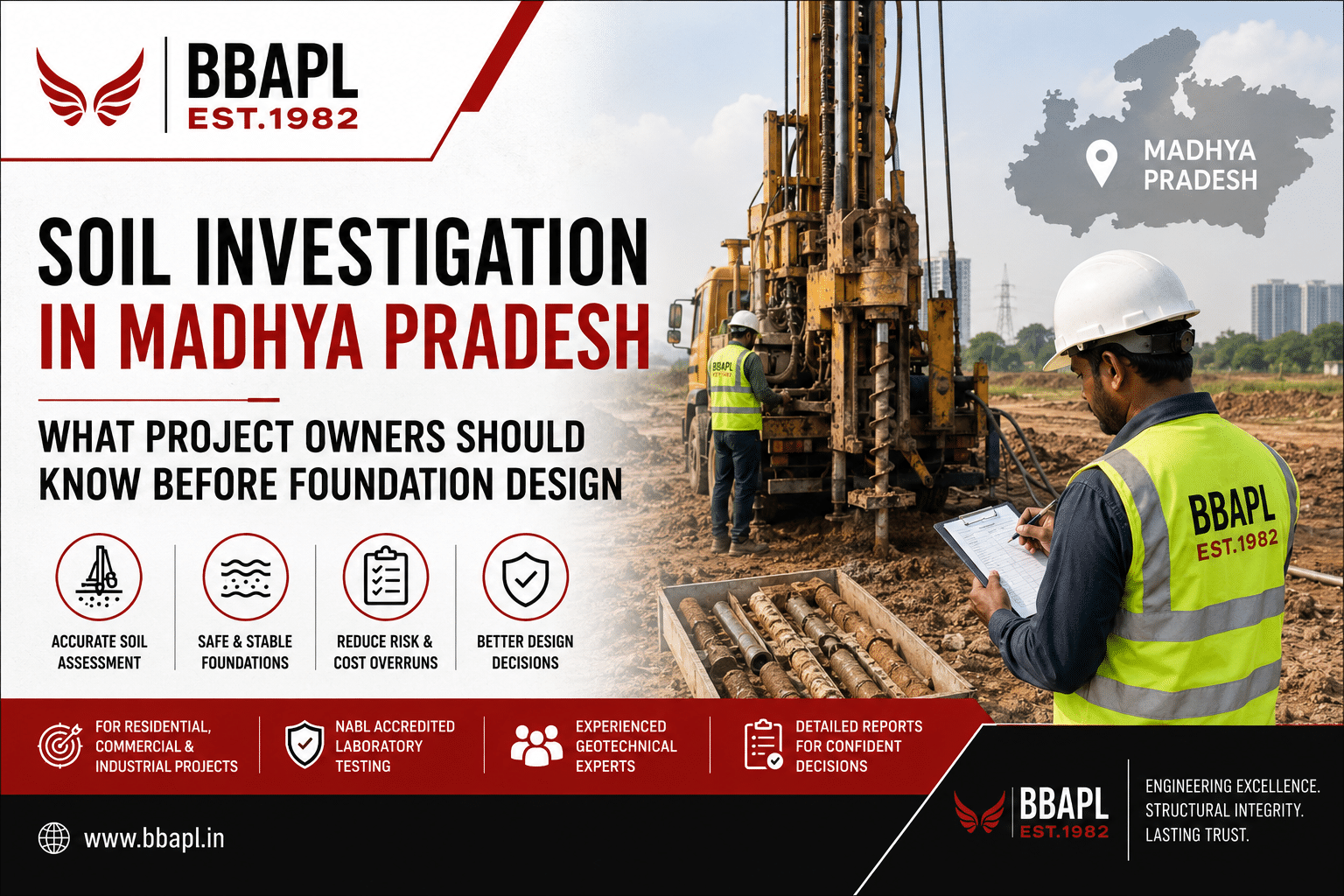
Foundation design should not be based on structural loads alone. The foundation system must also respond to the engineering properties, stratification and groundwater conditions of the supporting ground. This is why a site-specific geotechnical investigation is an important input before finalizing foundation design.
In the field of structural engineering, a foundation is the connection between the load on the structure and the ground. Foundation design based on building loads only is a high-risk gamble; for this reason, one must check the subsurface conditions of Madhya Pradesh (where expansive soils constitute 47.6% of the total geographical area, ICAR-NBSS&LUP) (ScienceDirect). A detailed soil investigation is essential in Madhya Pradesh to avoid foundation failure, manage budgetary costs of buildings, and provide long-term safety.
Madhya Pradesh has a variety of geological structures. Foundation assumptions are generalised and may be inaccurate where subsurface conditions vary.
Expansive soils can undergo significant volume changes when their moisture content varies. If these movements are not properly assessed and accommodated in foundation design, they may contribute to differential movement, cracking and serviceability problems.
Engineers have to deal with a variety of problems: hard basalt rock, weathered shale, or stratified rock in the form of sandstone in different areas such as Gwalior, Rewa, and the Vindhya or Satpura belts.
Soil cover can be shallow, but underlying rock fractures and sloping strata can lead to differential settlement or high excavation expenses if not identified prior to design.
Near river basins (Chambal, Betwa and lower Narmada), soil profiles are in the form of soft silt, loose fine sand, and a high water table.
Low bearing capacity areas are found in these zones and need detailed settlement investigations to avoid gradual structural settlement.
The Soil investigation in Madhya Pradesh provides you with knowledge of the ground profile at your site, so that you can avoid soil issues in the region.
No more missing foundation soil testing; it’s a violation of urban planning and building safety codes.
In addition, the urban local bodies like Bhopal Municipal Corporation (BMC), Indore Development Authority (IDA), and Gwalior Municipal Corporation demand validated geotechnical investigation reports for approval of building plans for multi-floor residential, commercial, and industrial buildings.
Project-specific approvals and structural design requirements may require geotechnical investigation and supporting soil data, particularly for larger, multi-storey, industrial and infrastructure projects. Project owners should confirm the requirements applicable to their site and approving authority before proceeding with foundation design.
A stability certificate is required and must be signed off by registered structural engineers for public and private structures. The structural consultants require a detailed report from an accredited soil testing lab MP before they provide details of foundation reinforcement to limit liability and safeguard public safety.
In India, geotechnical exploration and foundation design are regulated by certain Indian standard codes (IS) of the Bureau of Indian Standards (BIS):
A thorough geotechnical investigation Madhya Pradesh consists of three sequential phases: field exploration, laboratory testing, and engineering analysis.
Monitor seasonal groundwater to schedule site dewatering, basement damp-proofing, and waterproofing as needed.
A foundation should never be chosen on a trial-and-error basis or be duplicated from a nearby lot. The basis of foundation selection is the actual safe bearing capacity (SBC) and subsurface soil stratification.
Simple isolated footings (open-excavation) are allowed if soil testing MP shows stable sand, gravel, hard basalt at shallow depths (1.5m to 3.0m). This reduces the amount of excavation and structure required.
When building over expansive clays, shallow footings risk lifting or cracking during seasonal moisture cycles. Geotechnical engineers recommend Under-Reamed Piles (per IS 2911 Part 3).
A contiguous Raft Foundation made of reinforced concrete distributes the loads of the structures evenly over the entire area of the building (in soft alluvial or variable soil strata, where the bearing capacity varies in one part of the site to another).
The financial insight gained from carrying out a site investigation is between 0.2% and 0.8% of the total construction costs, but can save up to 10% to 20% in foundation material waste and reduce the risk of structural failure (fhwa.dot.gov).
If you are using a soil testing lab to design your foundations, use this checklist to make sure you are using the right data for your design:
Skipping these checks can result in unreliable soil data, incorrect foundation assumptions, and avoidable design or construction issues.
In short: A geotechnical investigation is only as useful as the quality of its fieldwork, testing, interpretation, and final report.
A successful construction project relies on a safe, stable foundation. With Madhya Pradesh’s varied geological profile, from expansive Black Cotton clays to hard basalt rock, conducting a professional soil investigation in Madhya Pradesh is a necessary step before foundation design begins.
At Bhargava Building Atelier Pvt Ltd (BBAPL), we bring over 45 years of trusted engineering experience to provide end-to-end engineering consultancy solutions, including geotechnical investigations, structural design, and material testing. Reach out to us today at +91-9630150426 or info@bbapl.in, or visit our head office at F-123, Vijaya Nagar, Gwalior, 474001 (M.P.) to ensure your project is built on verified, safe ground.
Soil testing determines the Safe Bearing Capacity (SBC) and physical properties of the soil. It ensures the structure is safe, prevents foundation cracking or settlement, and is mandatory for municipal building plan approvals in MP.
Black Cotton soil contains expansive montmorillonite clay that swells significantly when absorbing monsoon moisture and shrinks/cracks during summer heat. This movement causes extreme pressure on shallow footings, leading to structural cracks.
Under-Reamed Pile foundations (per IS 2911 Part 3) are recommended for expansive clay zones. Their enlarged concrete bulbs anchor the structure deep into stable strata below the swell-shrink zone.
A geotechnical site investigation typically accounts for just 0.2% to 0.8% of total project construction costs, but it can save 10% to 20% in structural materials by preventing foundation over-design.
Borehole depth depends on the proposed building’s height and structural load. Generally, boreholes range from 3 meters for lightweight structures up to 10–15 meters (or until hard bedrock is reached) for multi-story buildings.
A standard investigation includes field tests like the Standard Penetration Test (SPT) and Plate Load Test, combined with lab tests such as Atterberg Limits, Free Swell Index (FSI), and direct shear strength tests.
Skipping soil testing risks under-designing footings (leading to wall cracks, building tilting, or collapse) or over-designing footings (wasting millions of Rupees on excessive concrete and steel reinforcement).
Fieldwork and borehole sampling usually take 1 to 3 days depending on site size, followed by laboratory analysis and final technical reporting within 3 to 7 business days.
With over 45 years of experience, BBAPL provides comprehensive geotechnical investigation services, including borehole drilling, NABL-standard laboratory testing, groundwater analysis, and custom foundation engineering recommendations tailored to MP’s regional soils.
You can reach BBAPL by phone at +91-9630150426, email at info@bbapl.in, or visit their head office at F-123, Vijaya Nagar, Gwalior, 474001 (M.P.) to discuss your project requirements.
Talk to Our Experts Today — We're just a call or message away.

Already a member? Sign in now