In the rapidly growing industry today, structural safety and legal compliance are not only a regulatory obligation, but they are also an important duty of all businesses. To ensure that an industrial structure is safe to operate and meets government requirements, a factory building stability certificate is required under the Factories Act, 1948. This certificate ensures that the industrial structure is safe to operate and complies with government standards.
Being an NABL-approved and empanelled structural consultancy, Bhargava Building Atelier Pvt. Ltd. (BBAPL) has assisted the industries in MP to get their Factory Stability Certificate with precision, efficiency, and complete regulatory compliance.
In this blog, we will clearly explain what a Factory Stability Certificate in MP is, why it is required, and provide a step-by-step guide to help you obtain it smoothly without delays.
A Factory Stability Certificate (MP) is a government document issued by a competent person (CP) recognized by the Directorate of Industrial Health and Safety (DIHS), Government of Madhya Pradesh. It indicates that the condition of an industrial structure, including its foundations, columns, beams, roof truss, and floors, is structurally safe and stable for industrial use.
This certificate entitles you to certify that your factory building has been structurally assessed for compliance with safety provisions as outlined in the Factories Act and applicable state rules. The certificates are generally valid for five years and must be renewed after this period has lapsed.
As per Rule 3-A MP Factories Rules 1962, obtaining a stability certificate is mandatory for ensuring structural safety and legal compliance.
Industrial buildings endure substantial loads, dynamic motion from machines, and environmental factors. If structural deterioration isn’t detected and repaired through the inspection process, it could lead to a serious accident, operational interruption, or fines.
Here are some reasons it is important to obtain a factory stability certificate in MP:
You can also read our detailed guide on Why Factory Compliance in MP Is Under Sharp Focus in 2026 where we have covered the latest regulations, inspection trends, and certification requirements in depth.
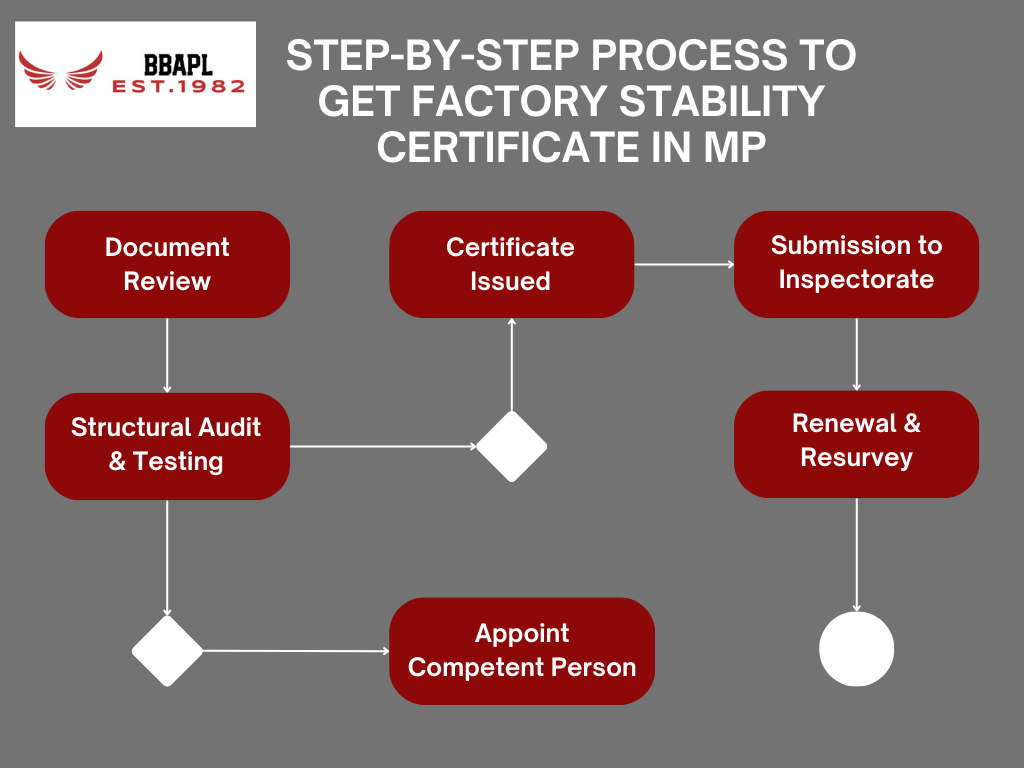
Obtaining a Factory Stability Certificate in Madhya Pradesh may look difficult, but BBAPL makes the process simple. Our team guides you at every step and ensures full compliance with the Factories Act, 1948. You get clear instructions, fast documentation support, and a smooth approval process. Here is an easy step-by-step overview to help you understand how the certification works.
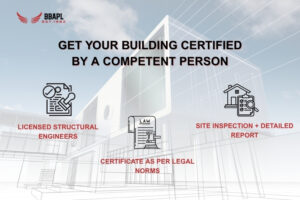
Only a Competent Person (CP) recognized by DIHS MP can issue the certificate, often referred to as a competent person certificate, for MP factories’ requirements for compliance. BBAPL employs a federal competent person to conduct inspections and provide stability certifications following state regulations.
The structural audit of the industrial building forms the foundation of the process. A structural audit consists of assessing all structural components at your factory to evaluate current conditions and load capacities.
BBAPL labs are NABL-accredited and can evaluate the structures with various advanced tests, including:
All of these tests will support the identification of any signs of distress, corrosion, or weak structural conditions, should any need for repair or reinforcement arise.
After the tests and inspections have been completed, the data is disclosed for an assessment to ascertain safety and compliance regarding the structure. The following documents are usually required:
BBAPL aids clients in compiling and verifying all necessary documents so that the effectiveness is not hindered.
Once the structural assessment and verification have been completed, the Competent Person issues a Factory Stability Certificate, which certifies the factory as stable and safe for industrial use.
This provides the following essential information:
You must send the issued certificate to the Factory Inspectorate in the Labour Department, MP, for approval and record. BBAPL assists clients with this submission and ensures compliance with procedural requirements.
The Factory Stability Certificate is valid for five years (or the authority). The industry must perform a new structural audit before expiration to reapply for certification. Timely factory stability certificate renewal MP is essential to avoid penalties and ensure uninterrupted factory operations.
BBAPL provides periodic inspection and renewals, ensuring your facility continues to meet compliance and remains risk-free through its operational life.
To secure a Factory Stability Certificate in Madhya Pradesh, you must present significant documents that confirm the ownership, structural information, and the condition of the operational load. With these documents, the Competent Person can evaluate the safety, compliance, and structural integrity in the right way.
Many factories in Madhya Pradesh face delays or rejections during certification due to incomplete documents, outdated building plans, or a lack of accredited testing data. BBAPL’s factory compliance services tackle each of these:
Also Check: Structural Stability Certificate: Frequently Asked Questions
For more than 40 years, Bhargava Building Atelier Pvt. Ltd. (BBAPL) has provided clients throughout Madhya Pradesh with structural design, safety audits, and industrial compliance services. Our approach is to integrate engineering, regulatory experience, and scientific lab support.
BBAPL Factory Compliance Services Include:
With BBAPL, industrial owners can have a compliance partner that understands the technical and administrative aspects of factory certification.
Acquiring a Factory Stability Certificate in MP is not merely procedural; it is an important step towards creating a safer, compliant, and more sustainable industrial environment in MP. This can involve conducting regular structural audits of industrial buildings, in partnership with a Competent Person (as licensed/recognized in MP) to ensure continued safe operational capacity and long-term legal assurances.
With BBAPL’s factory compliance services, you can be confident in certified expertise, NABL-tested reliability, and ease of compliance. Stay compliant. Stay safe. Build strong, with BBAPL.
Ready to get your Factory Stability Certificate without delays? Contact BBAPL today for a guided, hassle-free certification process.
A Factory Stability Certificate is an official document issued by a Competent Person, certifying that an industrial building is structurally safe and compliant with applicable safety regulations under the Factories Act.
Yes, it is mandatory under Rule 3-A of the MP Factories Rules, 1962, especially for factory licensing, renewal, and compliance with safety regulations.
Only a Competent Person (CP) recognized by the Directorate of Industrial Health and Safety (DIHS), Madhya Pradesh, is authorized to issue the certificate.
The validity typically ranges from 1 to 5 years, depending on the factory’s condition and DIHS guidelines. Renewal requires a fresh structural audit.
If the certificate expires, it may lead to: Factory license renewal rejection Legal penalties or notices Increased safety risks for workers and operations
Yes, it is a mandatory requirement for obtaining or renewing a factory license in Madhya Pradesh.
Key documents include: Approved building drawings and layout Ownership or lease documents Machinery load details Previous stability certificate (if available) Repair or retrofitting records Owner/occupier ID details
Common tests include: Rebound Hammer Test (RHT) Ultrasonic Pulse Velocity (UPV) Core extraction and compressive strength testing Rebar detection and cover mapping Foundation and roof inspection
A structural audit is generally required every 1 to 5 years, depending on building age, condition, and regulatory requirements.
The cost varies based on: Factory size and complexity Required testing and inspection scope Structural condition of the building
Yes, but it may require detailed structural assessment, testing, and possible retrofitting to meet safety standards before certification.
The process duration varies based on factory size and documentation readiness but typically ranges from 7 to 21 working days when handled by an experienced compliance consultant.
Talk to Our Experts Today — We're just a call or message away.

Already a member? Sign in now