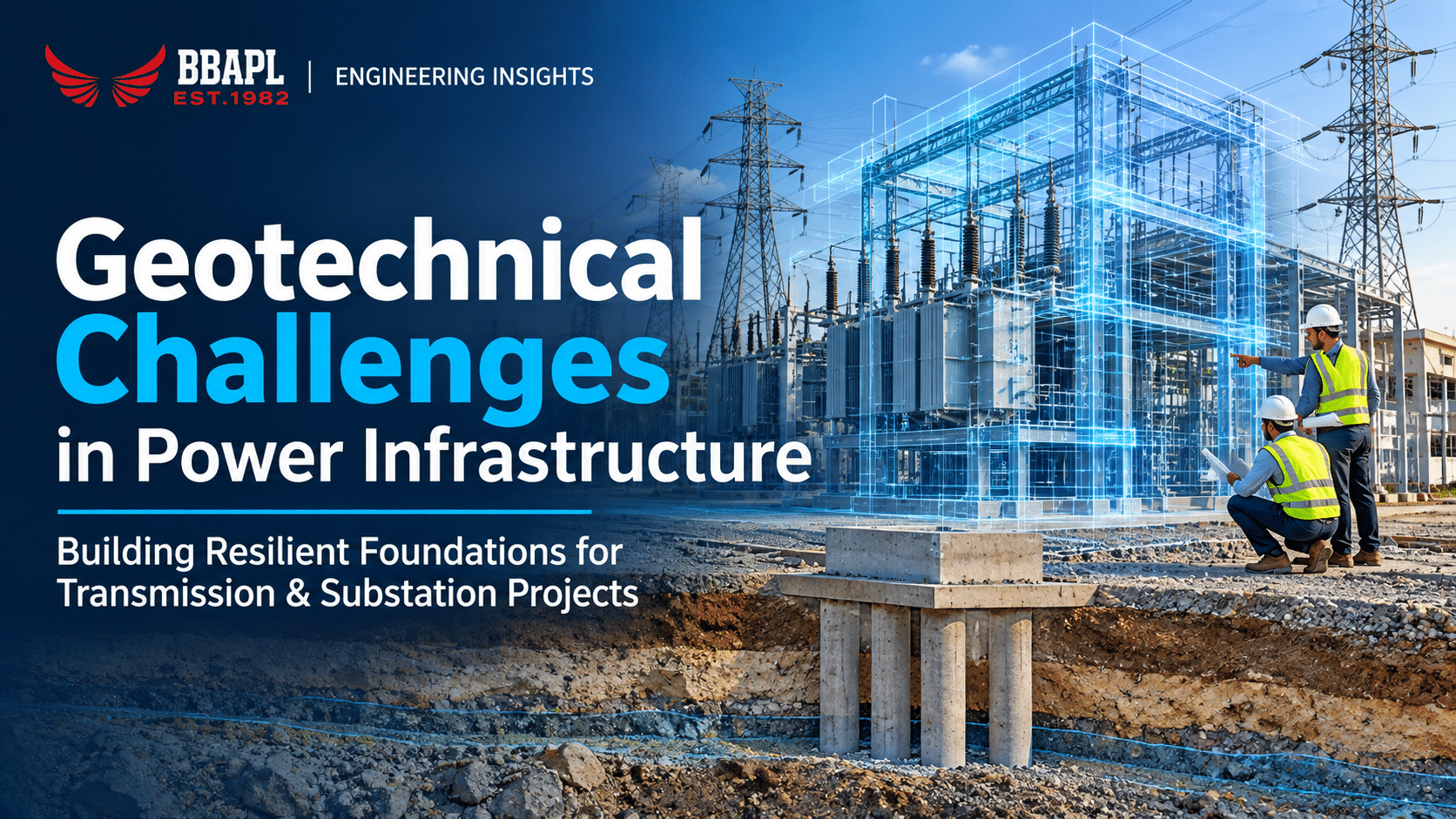
What happens when a high-voltage electrical grid supplying gigawatts of power meets unstable, uncoordinated, or weak ground?
Sprawling substations secure ultra-heavy transformers and delicate switchgear, and modern transmission corridors crisscross flood-prone coastal plains and rugged mountains. Industry experts, such as the Central Electric Authority (CEA), state that unplanned subsurface ground failures make up more than 25% of foundation distress and construction delays on utility corridors. In countries that are rapidly modernizing, such as India, soil stability is directly related to the survival of the networks.
In this blog, you will get to know the major geotechnical challenges faced by power networks and some important techniques for soil testing, uplift and dynamic load analyses, along with future-proofing approaches to create resilient utility foundations.
Geological Diversity and Subsurface Complexity Across Linear Corridors
The challenge for linear power corridors is very different from that of the concentrated industrial complex: They span dozens of different geological layers in the project corridor. Engineering teams have to plan the foundations to be able to cope with the very different terrains every few kilometres.
- Expansive Clays (Black Cotton Soils): These clays are rich in montmorillonite and are found throughout the Deccan basalt region in Central and Western India and are extremely expansive and shrink when wet and swell when dry, respectively. This cyclic swell-shrink action creates great lateral pressure and heave on shallow footings.
- Loose Alluvial and Saturated Sands: These are the cohesionless, loose saturated soils found along the northern river basins and agricultural corridors and are significant for primary consolidation, low bearing capacity, and seismic liquefaction.
- Coastal Subsurfaces: In the near-marine and brackish areas, soil and groundwater have high levels of chlorides and sulfates, which accelerate the chemical attack on embedded steel piles and concrete footings.
- Hilly and Landslide-Prone Terrains: Steep Himalayan and Western Ghat routes present fractured bedrock, steep slope instability, rockfall, and erosion issues requiring engineered systems for slope stabilization as well as deep foundations.
Seasonal monsoons can significantly raise the water table, reducing soil stress by 50% and increasing stress factors for both tower stubs and base pads for substations.
Rigorous Geotechnical Investigation for Power Projects
For power projects, performing a thorough geotechnical foundation design has to balance extensive sampling of the site with a wide geographic scope. Hundreds of different borehole evaluations could be needed for a single transmission line that crosses 200 kilometers.
- Desk Study: Analysis of geological maps, satellite remote sensing data, historical earthquake activity, and hydrological flood data to identify high-risk areas early in the alignment process.
- Strategic Borehole Placement: Exploratory boreholes were normally sunk at regular intervals, and at every critical angle, dead-end, and river-crossing position of towers, and were usually shallow, 10 to 30 m deep or a few m into hard rock.
- Standard Penetration Testing (SPT): Making standard penetration tests periodically (usually every 1.5 to 2.0 m) to determine empirical N-values, stratigraphy consistency, and relative density of subsurface.
- Field Electrical Resistivity Testing (ERT): Testing soil resistivity at different electrode spacings (Wenner four-pin array) to verify that electrical grounding grids at substations function safely to dissipate fault currents without creating hazardous step and touch potentials.
- Chemical Characterization: Sampling of subsoil and perched water tables to establish the pH level, TDSS, sulfate and chloride ion levels, and to determine if sulfate-resistant Portland cement is required or if cathodic protection should be used.
High-Precision Substation Soil Testing and Static/Dynamic Load Analysis
A substation soil test provides a comprehensive evaluation of the ground, foundation stability, settlement potential, and vibration characteristics to enable the safe and reliable operation of critical electrical equipment.
- Soil Bearing Capacity: Plate Load Tests (PLT) and triaxial shear tests are used to assess the strength of the soils and bearing capacity of heavy transformer foundations and equipment plinths.
- Differential Settlement Control: Evaluating the potential for settlement is used to avoid misalignment of the equipment, stress on the busbar, and damage to the ceramic insulators and high-voltage bushings.
- Dynamic Soil–Foundation Interaction: Assess soil and foundation response to operational vibrations to minimize risks of excessive vibration and resonance.
- Drainage and Groundwater Management: Good site drainage and groundwater management prevent waterlogging, softening of soil, and foundation instability during monsoons.
Transmission Tower Foundation Testing: Overcoming Uplift, Thrust, and Overturning
High-voltage transmission towers are considered to be large vertical cantilevers, as opposed to the typical commercial building where the vertical load dominates. Tower foundations are subjected to violent structural reversals under strong wind conditions and broken wires.
- Dominance of Uplift Forces: When Uplift Forces are dominant, wind shear forces are exerted on the windward legs of a self-supporting lattice tower, which create considerable uplift forces that must be resisted by the foundations in tension, pulling out of the ground.
- Lateral Shear and overturning moments: These are extremely high bending moments at the base plate interface due to extreme lateral thrust from angled or termination towers, requiring high-grade lateral resistance.
- In-Situ Transmission Tower Foundation Testing: Engineers conduct full-scale static uplift pullout tests, lateral load tests, and dynamic pile integrity testing (PIT) to ensure the placement of anchors, microradials, or pile shafts is performing at the designed safety factor.
- Foundation Tailoring:
- Pad and Chimney Footings in cohesive, dry ground using backfill surcharge weight to anchor against uplift.
- Under-Reamed Piles with enlarged bulbs to lock deep into expansive or medium-soft clays.
- Rock Anchor Foundations drilled and grouted directly into hard formations, leveraging rock socket tensile capacity to handle tension.
- Bored Cast-in-Situ Piles in soft deltaic alluvium to mobilize friction and end-bearing capacity simultaneously.
Advancing Infrastructure Engineering in India: Mitigating Unique Regional Hazards
The context in which modern infrastructure engineering India will be carried out in India today is unprecedented, characterized by a need to create large-scale green energy corridors within a state of severe environmental vulnerabilities and complex seismic areas.
- Seismic Vulnerability (Zones IV and V): Dynamic seismic vulnerability assessment is needed for power grids that cross the Himalayan collision belt, Northeast India, and Kutch. For saturated alluvial soils, the design models should be based on cyclic stress ratio (CSR) criteria for liquefaction potential.
- Desert Sand and Dune Shifting: Rajasthan and Gujarat have deserts and dunes that migrate, causing renewable wind and solar energy transmission lines to suffer from shifting or non-cohesive sands, which demands special chemical stabilisation, geo-cells, or deep pile caps.
- Scour and Sub-Bed Erosion at River Crossings: Dynamic riverbed scouring is observed during floods in major rivers, such as the Ganga, Brahmaputra and Narmada. Extensive hydrologic-geotechnical evaluations are needed to place foundations for towers in floodplains, with pile caps installed well below calculated maximum scour depths (ds).
- Urban Right-of-Way (RoW) Constraints: Compact Footprint Structures such as steel monopoles are needed for Suburban Grid Extensions in Urban Right-of-Way (RoW) Constraints. Monopoles transmit high overturning forces through a single point, which requires that the shafts be large-diameter, drilled foundations, and the mechanism for the rock socket be complex.
Ground Improvement and Innovative Foundation Remediation
If unstable ground is found during subsurface testing, it is very difficult to avoid the route, as there are very tough Right-of-Way regulations and land acquisition problems involved. Ground improvement technology, along with new and non-destructive testing technologies, is becoming more prevalent in geotechnical teams stabilizing marginal sites.
- Stone Columns (Vibro-Replacement): They are used to reduce susceptibility to liquefaction, to provide immediate consolidation of pore water in soft cohesive silts and marine clays, and to increase the composite shear strength.
- Chemical Stabilization and Grouting: High-pressure grouting with chemical cementitious or micro-fine cement to solidify fragmented rock blocks, fill underground cracks, and enhance the capacity of structural footings under moving switchyard equipment.
- Geosynthetic Reinforcement: Protection of shallow cable trenches, reduction of differential settlement, and distribution of bearing stresses under substation access roads and switchyard subgrades are achieved using geosynthetic reinforcement that incorporates both biaxial and triaxial geogrids.
- Micro-Piling Solutions: Small-diameter drilled and grouted piles offer low disturbance, high compressive and tensile capacity, and are the perfect solution for an upgrade of an existing substation foundation.
The Road Ahead: The Future of Resilient Energy Foundations
Modern power systems are quickly evolving and are now characterized by the integration of gigawatt-scale renewable parks, HVDC interconnections, and multi-circuit transmission lines, which are imposing new demands on the foundations of power systems. The old way of applying standardized regional foundation designs is fast becoming a thing of the past, as subsurface designs are increasingly engineered locally using data.
The fiber-optic sensors and the piezoresistive health-monitoring systems for detecting real-time micro-settlement, scour progression, and lateral deformation in power grid foundations will be incorporated into tomorrow’s power grid foundations. Paired with digital twins, automated continuous subsurface scanning and machine learning models predicting soil-structure interactions under extreme climate anomalies, geotechnical engineering will not only provide structural support, but also become an active and intelligent defense line. From the ground up, on solid geotechnical data, energy infrastructure can be truly physically resilient to support the electrified and carbon-neutral future.
People Also Ask
-
Why is geotechnical investigation critical for power projects?
It identifies subsurface soil properties, water table depth, and rock strata, preventing differential settlement, structural tilting, and catastrophic foundation collapse.
-
How do transmission tower loads differ from building loads?
Buildings primarily exert downward compressive gravity loads, whereas tall transmission towers face extreme uplift (tension), overturning moments, and lateral forces from severe wind and broken-wire conditions.
-
What is the standard foundation testing for transmission towers?
Engineers conduct static uplift pullout tests, lateral load tests, and dynamic pile integrity testing (PIT) to verify resistance against pullout and shear forces.
-
Why is soil bearing capacity analysis essential for substations?
Massive, concentrated loads from 500 MVA power transformers and heavy switchgear require precise safe bearing capacity (qnet) values to prevent shear failure and uneven settling.
-
How do expansive "Black Cotton" soils affect power foundations?
These montmorillonite-rich clays swell and shrink drastically during wet and dry cycles, exerting intense lateral pressure and vertical heave on footings.
-
What is the role of soil electrical resistivity testing (ERT) in substations?
ERT measures how effectively the ground can dissipate high-voltage fault currents, ensuring the grounding grid maintains safe step-and-touch voltage thresholds.
-
How are transmission towers secured in deep river floodplains?
They use deep bored cast-in-situ concrete piles anchored well below the calculated maximum scour depth (ds) to withstand annual riverbed erosion.
-
What solutions are used for rocky or mountainous terrains?
Engineers install drilled and grouted rock anchor foundations, utilizing the rock’s tensile strength and socket shear resistance to counter strong wind-induced uplift.
-
Why must dynamic vibrations be tested under transformer plinths?
Heavy transformers and shunt reactors emit continuous low-frequency vibrations; foundations must be tuned away from operational harmonics to prevent damaging resonance.
-
What ground improvement techniques treat weak substation subsoils?
Common remediation methods include installing vibro-replacement stone columns, high-pressure permeation grouting, micropiling, and laying biaxial/triaxial geogrids.