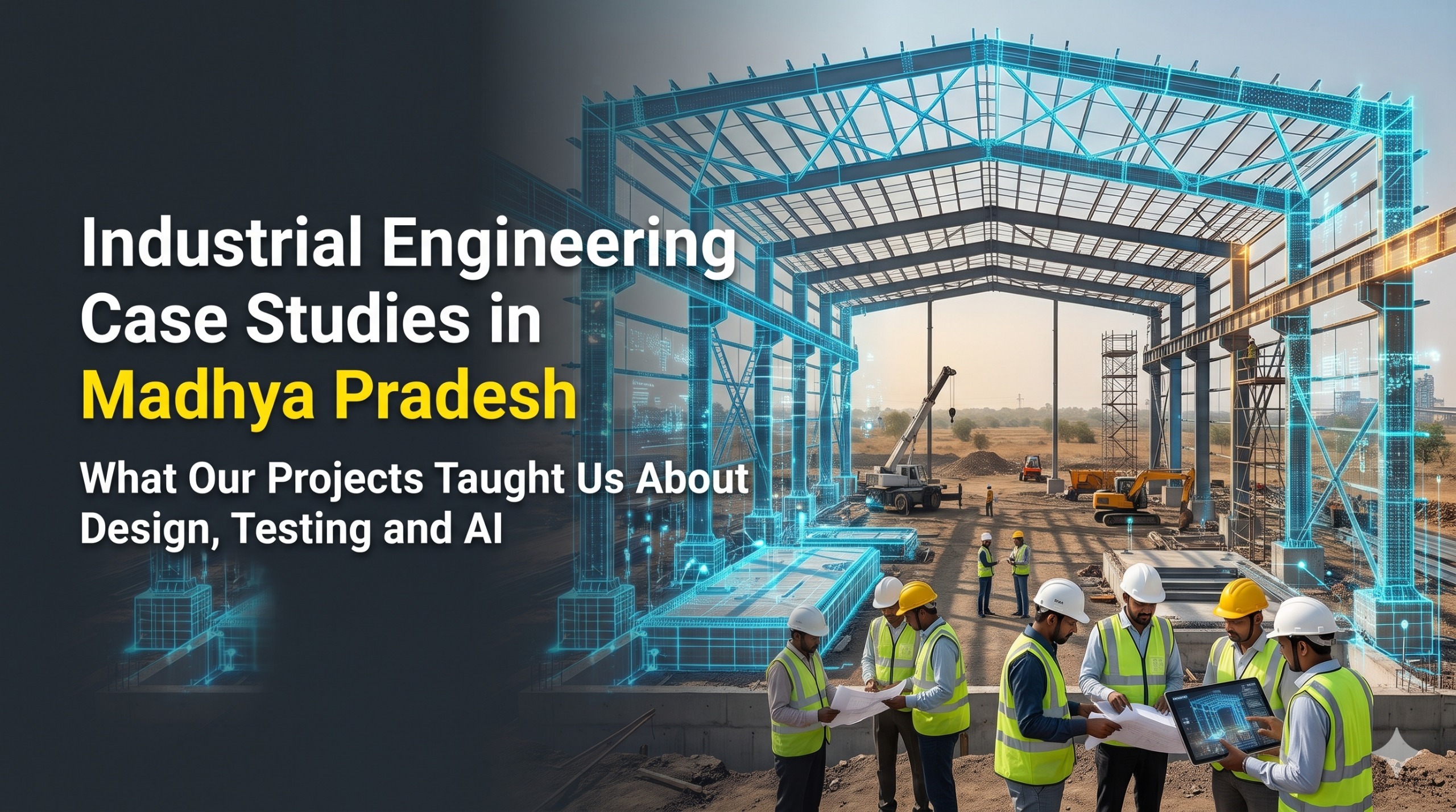
A shed is easy to see from the road. However, a shed with a bent drive through, or a brick batch that cracks after the walls are erected, can create years of lost productivity for a company. Most structural issues start with a decision that is taken on paper.
India is scaling up its construction projects. Public capital expenditure has been estimated at Rs 12.2 trillion or 3.1% of GDP in the Union Budget 2026-27 compared to Rs 11.2 trillion in the 2025-26 budget (Indianinfrastructure).
We have worked on factories, power infrastructure, bridges and highways at Bhargava Building Atelier Pvt. Ltd. (BBAPL). In this blog, you will understand what we learned from our industrial engineering case studies in Madhya Pradesh with regards to design, testing, and the judicious application of AI in engineering.
Project Overview
BBAPL provided civil and structural engineering consultancy for the expansion of CG Power’s Malanpur facility, covering multiple industrial sheds with different operational requirements.
Engineering Challenge
BBAPL’s Solution
We provided civil and structural engineering design, including 3D views and engineering drawings, for:
Project Outcome
The engineering design addressed the distinct functional requirements of each shed and provided the structural planning needed for the facility expansion.
Project Overview
BBAPL provided engineering consultancy for additional infrastructure and expansion requirements at Wavin’s Banmore manufacturing facility.
Engineering Challenge
BBAPL’s Solution
We provided engineering support for:
Project Outcome
The project addressed the facility’s additional infrastructure requirements through dedicated production and storage spaces, with provisions for machinery operations and material movement.
Project Overview
BBAPL undertook a structural audit and assessment of the existing Kurlon facility to evaluate its structural condition and safety.
Engineering Challenge
BBAPL’s Solution
Our team conducted a structural assessment to evaluate the existing building condition, identify potential concerns and recommend necessary corrective measures.
Project Outcome
The recommended corrective measures were completed within the project timeline, addressing the identified structural concerns and supporting the continued safe use of the facility.
Project Overview
These projects represent BBAPL’s engineering consultancy involvement across pharmaceutical manufacturing, power transmission and public infrastructure.
Engineering Challenge
Each project involved a different set of engineering requirements, ranging from industrial facility integration and structural assessment to infrastructure safety and technical compliance.
BBAPL’s Solution
Our engineering teams provided project-specific design, assessment and consultancy support based on the respective technical requirements.
Project Outcome
These engagements demonstrate BBAPL’s experience in addressing varied engineering requirements across industrial and infrastructure projects.
Note: Individual project details and measurable outcomes can be added once the specific scope and completion records are available.
Project Overview
BBAPL conducted clay brick testing for a DRDO project in Gwalior before the materials were used in construction.
Engineering Challenge
The project required verification of brick quality against applicable Indian Standards before acceptance for construction. Using non-compliant materials could lead to quality concerns at a later stage.
BBAPL’s Solution
Our NABL-accredited testing laboratory conducted tests in accordance with applicable IS standards, covering:
Project Outcome
The test reports provided documented evidence of material compliance with applicable requirements, supporting informed acceptance or rejection decisions before the bricks were used on site.
This enabled quality verification at the material procurement stage, helping identify non-compliant supplies before they became part of the structure.
Two sets of sheds stood at each Malanpur, each serving a different operation. Material flow and space are important for a winding shed. A locomotive shed is a shed used for maintenance and storage. The plant surrounding a utility shed must be able to fit around it.
However, at Banmore, dust control and ventilation influenced the design of the building itself, as the processing of plastics generates conditions that are not addressed by general design. There is another dimension of pharmaceutical plants: column position can impact equipment placement, and slab level can impact drainage and cleaning.
The first step in good factory engineering is process data, which comprises crane needs, equipment loads, movement paths, and expansion zones. It is much more cost-effective to design with safety and scope for future expansion than to make additions and alterations at a later stage.
Unlike factories, power lines, bridges, and highways have three things that make them different. They last for many years. They are crucial to public safety. They are also exposed to weather, vibration, and traffic on a daily basis.
This is why load assessment is even more critical, and codes and quality materials are even more critical. So does documentation. Future engineers can then rely on the asset’s inspection and maintenance when the assumptions, calculations, and test results are documented precisely. A good design will only be a good structure if it is built properly, and site supervision is just as important as design.
Both Kurlon audit and the DRDO brick testing have the same concept. Issues are cheapest to solve at the earliest stage.
The majority of structural problems show warning signs first: cracks, deflection, corrosion, and moisture. When left to their own devices, they cost more to repair. A planned audit is much cheaper than an emergency repair. A lab test is a lot cheaper than a rebuild. Both are about verifying facts before it’s too late.
AI tools are assisting us in real-world ways:
They also reduce the time spent on repetitive checks, providing more time for engineers to exercise judgement. They are best suited to the accuracy of the underlying data: accurate surveys, correct drawings, and verified test results.
AI cannot be held responsible for a structure. We have certain rules, and we stick to them:
Successful industrial and infrastructure projects are not defined by structural design alone. They depend on informed planning, accurate soil investigation, verified construction materials, proper structural assessments and effective project execution.
As India’s industrial and infrastructure sectors continue to expand, advanced technologies such as AI will help engineers improve design efficiency, identify potential conflicts and analyse complex engineering data. However, verified information, engineering expertise and professional accountability will remain essential.
At BBAPL, this is an area we anticipate will speed up, but never become less accountable. If you are in the midst of a plant, please contact our team at the beginning, not halfway through.
These are projects where engineers design the structural system of a factory or plant, such as sheds, frames, foundations and yards, around how the plant operates.
Each operation has different loads, spans and material flows. A winding shed, a loco shed and a utility shed each need their own structural logic.
It is a check of an existing building for damage, load-bearing capacity and safety compliance. It is needed when a structure ages, changes use or shows cracks, deflection or corrosion.
Testing confirms that materials meet code requirements before they go into the structure. Rejecting a weak batch early is far cheaper than repairing the structure later.
Compressive strength, water absorption, efflorescence and dimensional accuracy are standard tests, carried out as per IS standards.
Infrastructure like bridges, highways and power lines serves for decades, affects public safety and faces constant weather and traffic loads.
AI helps compare layouts, flag clashes between structure and services, screen photos for cracks and track material test trends across batches.
No. AI outputs must be verified against codes and site conditions, and the engineer remains responsible for the design.
We built a PVC Shed, a Pipe Yard, and a Grinding & Mixing Shed with ventilation and dust control, and expanded the existing PVC facility.
We designed the 2,000 sq.m Winding Shed, the 550 sq.m DT Winding Shed, the 400 sq.m Loco Shed, and the Utility and IPTS Sheds.
It identified damage, assessed load capacity and checked safety compliance. All corrective measures were completed on time and extended the structure’s life.
We tested clay bricks for compressive strength, water absorption, efflorescence and dimensional accuracy before site use.
No related posts found.
Talk to Our Experts Today — We're just a call or message away.

Already a member? Sign in now